
MTI Trend Study 2026 - Leadership in Transition

What Leadership Needs Today—and Why Implementation Often Fails
Companies know what good leadership requires—but in day-to-day operations, they often lack the time and the right conditions. The MTI Trend Study 2026 shows what skills leaders will need in the future, what obstacles are hindering their development, and why “ leadership development ” must be approached from a more systemic perspective.
The Study at a Glance
The online survey was conducted from June through August 2026 among executives, HR managers, and experts in human resources development. A total of 162 survey responses were collected. The number of valid responses varies by question.
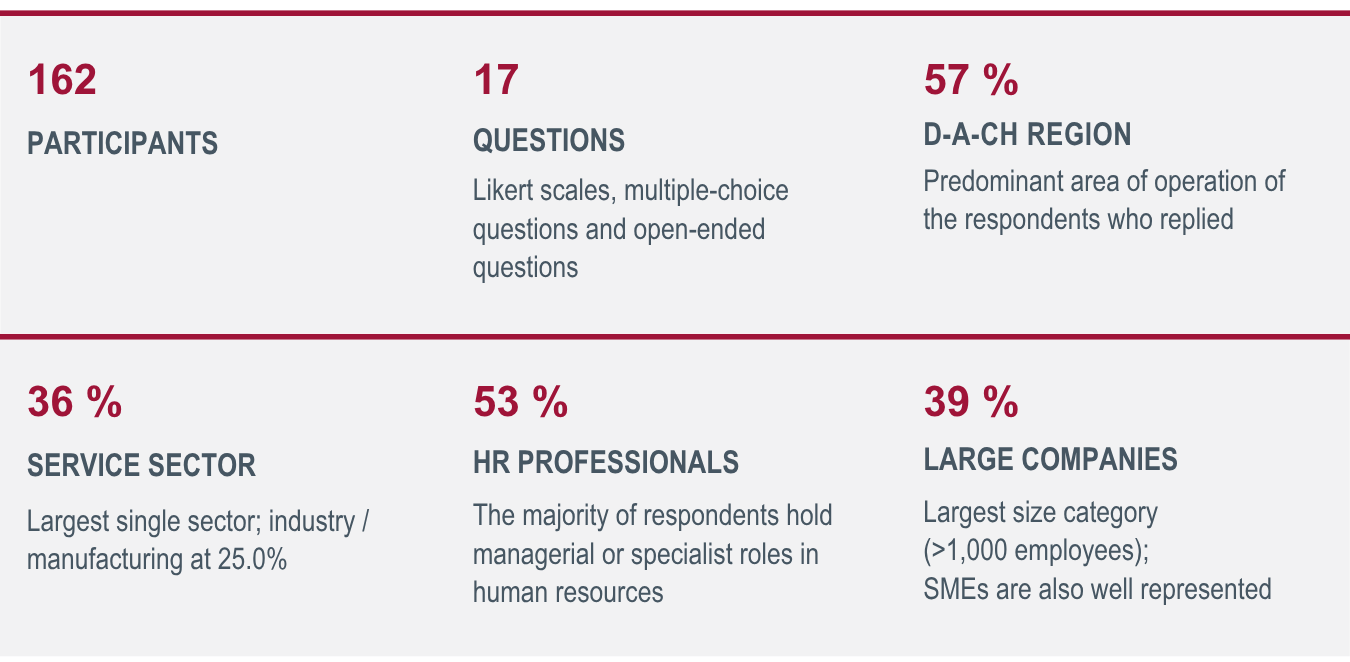
With 53 percent of respondents holding HR roles, the study primarily reflects the HR perspective. Managers outside the HR department are also well represented, at 34 percent; on key future issues, both groups share similar overall assessments.
Leadership is becoming more coaching-oriented
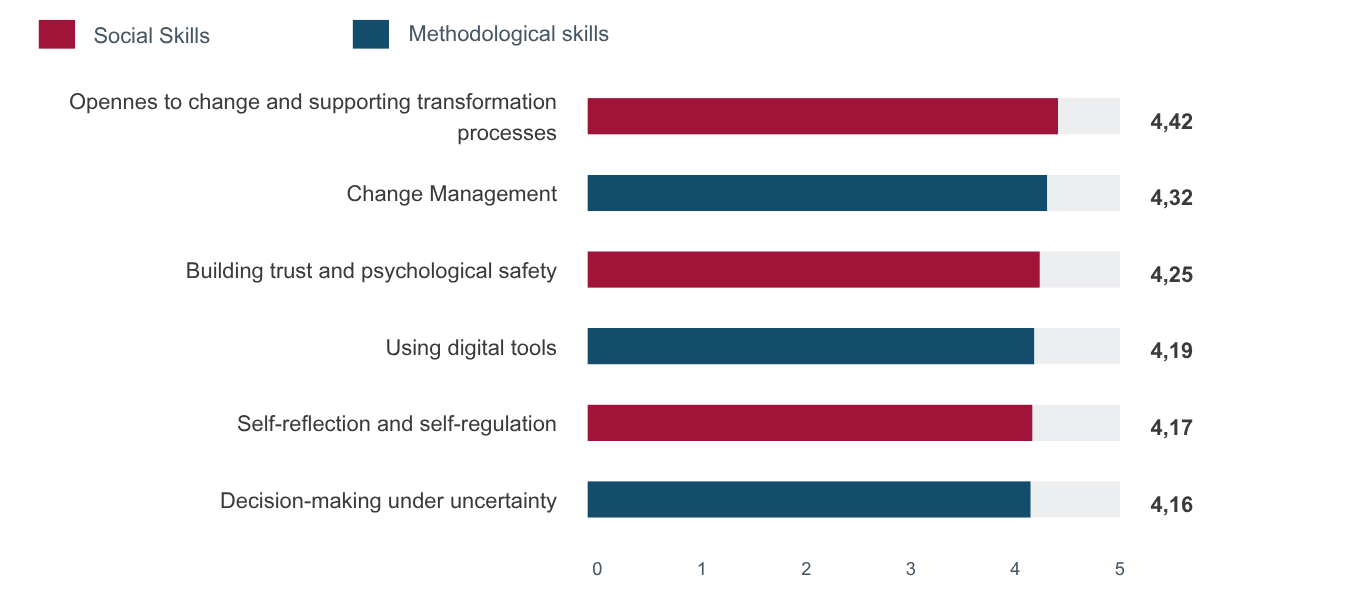
Openness to change, at 90.6 percent, is the most important skill for the future. Hierarchical leadership, by contrast, scores only 12.5 percent at the highest level of relevance. Coaching and communication skills are rated particularly highly (4.37 out of 5), followed by resilience and stress resistance (4.04).
Leadership should therefore focus less on control and more on empowering people. Leaders must do more than just manage change at the organizational level. They must provide guidance, tolerate uncertainty, build trust, and support employees in their development.
Potential for Action: Change management skills should not be treated as a specialized qualification for individual transformation projects. In the future, they will be part of every leader’s core skill set. The study also recommends consciously reflecting on hierarchical leadership styles and evolving leadership more toward the roles of enabler and sparring partner.
These skills are becoming increasingly important
Time is the biggest bottleneck
About 70 percent cite a lack of time and pressure to be productive as the biggest obstacle to leadership development. Technical hurdles play a significantly smaller role, at 18 percent. But a lack of support is also a hindrance: About half of the respondents cite a lack of acceptance of development measures among management; just under half also point to budget constraints.
Opportunities for Action: Time for leadership and development should be deliberately planned and safeguarded. Learning formats that can be integrated into the daily work routine—such as coaching, digital learning paths, or on-the-job training—help to embed development in a sustainable way.
| "Leadership should be less about control and more about empowering people." |
Digitalization and AI: Drivers and Tools
69 percent view digital transformation as a key challenge, and 84.3 percent consider the use of digital tools to be a particularly important leadership skill. AI is primarily seen as an enabler of more efficient processes, better access to information, and new forms of collaboration.
At the same time, technology is accelerating change. The essence of good leadership remains human: building trust, providing direction, resolving conflicts, and guiding people through change.
Potential for Action: Digital literacy should be linked to adaptability, communication, and self-reflection, and should not be viewed as an isolated technical issue.
The greatest leverage is systemic
Future-ready leadership does not result from a single measure. The study shows that selection, ongoing development, time for leadership, clear expectations, and a culture based on trust must all work together.
Recommended Action: " leadership development " requires visible support from senior management, clear leadership standards, and shared responsibility. Development becomes more effective when recruitment, talent development, feedback, and succession planning are integrated.
From Individual Training to a Learning Architecture
The preferred development formats point in a clear direction: 55 percent focus on coaching for current leaders, 47 percent on coaching and mentoring skills, and 46 percent on digital learning paths, microlearning, or learning analytics.
This shifts the focus from individual training sessions to a learning architecture. “Learning on Demand” means that learning takes place wherever specific leadership situations arise. In-person and online training sessions remain important learning environments, but they become more effective when self-directed learning, coaching, digital prompts, practical application, and feedback are integrated.
For the next 24 to 36 months, the study therefore identifies a clear task: Companies must bridge the gap between leadership aspirations and leadership reality. To do so, they do not primarily need more and more content, but rather better conditions for applying existing knowledge and developing new skills in a sustainable manner.
You can read the full MTI trend study, “Leadership in Transition 2026,” here:
From Insight to Application
Future-proof leadership does not result from a single training session, but rather from a well-thought-out development framework. MTI supports you with three tailored solutions:
MTI CONVERSA: Practice real-life conversation scenarios—with personalized AI feedback.
CoachingPRO: Provide targeted support for coaching and development processes and ensure knowledge transfer.
MTI 360° Leadership: Continuously and independently develop leadership skills with modular learning nuggets.