
Good days don't happen by chance – Why a strengths-based approach pays off for companies
Being good at something is a skill. Enjoying it turns it into a strength—and that’s where people perform at their best. In everyday corporate life, however, the opposite often happens: The best networker gets promoted to an administrative role, and performance reviews focus primarily on weaknesses. If you want to change that, you don’t need a major initiative—just a clear focus on the team’s strengths and small rituals in everyday life.
By Thomas Kleiner, Senior Consultant and Certified PERMA-Lead® Consultant at Machwürth Team International

Two Bakeries, One Difference
What makes for good leadership often becomes apparent where you least expect it: at the bakery around the corner, on the tennis court, or when you’re given the wrong bill. The following examples from everyday life show what really matters. Two bakeries on the same street sell the same rolls at the same price. At one, you’re rushed through. At the other, you’re greeted by name. Which one will you visit tomorrow morning?
The decision isn't based on the product, but on the relationship. And the way people interact with one another is, to a large extent, the result of leadership.
The same applies in the office. A sales team has been missing its targets for weeks. One manager leader responds with daily reports and more pressure. The other asks, “What’s holding you back, and what do you need from me?” Then she clears away the obstacles. Both want better results. But only one tries to understand what’s holding her team back.
That is exactly what Positive Leadership is all about: Good leaders are less like drivers and more like gardeners. A gardener doesn't pull on the plants to make them grow faster. He provides light, water, and good soil.
What Roger Federer Reveals About Leadership
A look at the world of sports illustrates how strengths can be used strategically: Roger Federer has won about 80 percent of his professional matches. However, he won only about 54 percent of all individual points—barely more than a coin toss. He wasn’t better in every rally. He was better at the right moment: on break point, set point, and match point.
In the workplace, this means: No one has to be the best at every task. What matters is using your strengths where they make a difference.
Everyday life often looks different. In performance reviews, there are three sentences of praise, followed by the “areas for development.” As a result, a lot of energy goes into trying to turn a weakness into mediocrity. Weaknesses that are harmful must, of course, be addressed. But the goal remains to let people shine where they are strong.
Ability is not the same as strength
A skill is something you can do. A strength is something you can do and enjoy doing. When the two come together, the result is what business psychologist Markus Ebner calls “authentic excellence”: maximum impact with minimal strain.
A classic example illustrates just how easily companies squander their strengths: The company’s best networker makes more contacts at a single trade show than others do in an entire year. As a reward, he becomes a team leader—and from then on spends his time on budget planning and capacity utilization spreadsheets. A brilliant networker turns into a frustrated administrator. It would be wiser to build the role around his strength and pair him with someone who loves spreadsheets.
Five Factors for Effective Leadership
Strengths-based leadership is a component of positive leadership. The approach has its roots in positive psychology. Psychologist Martin Seligman used the PERMA model to describe five factors that promote people’s well-being and personal growth. Markus Ebner drew on this to develop the PERMA-Lead leadership model.
PERMA-Lead Model
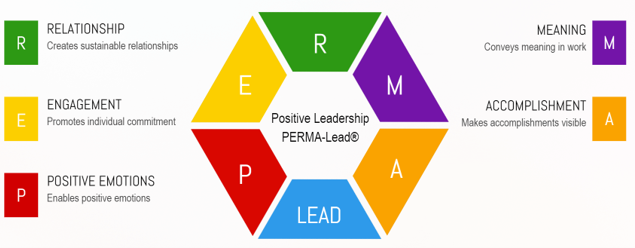
The five areas are positive emotions, engagement, relationships, purpose, and the experience of success. They describe what people need to develop their abilities. How leaders can create these conditions is particularly evident in their day-to-day interactions with their employees.
One wrong calculation, two teams
Nowhere is leadership more evident than in how mistakes are handled. Imagine two teams facing the same situation: An incorrect invoice is sent to a major client.
In Team A, the person responsible is reprimanded in front of everyone. The team learns one thing above all else: it’s better to hide mistakes. In Team B, the “ leader ” says, “Thank you for reporting this right away. How can we prevent this from happening in the future?” This team learns to address problems early on. And the sooner problems come to light, the greater the chance of limiting the damage.
A culture of error is therefore not a trivial matter. It is an early warning system. The prerequisite for this is psychological safety: People must be able to admit a mistake, ask a question, or disagree without being punished for it.
The Economic Impact of Good Leadership
Positive leadership doesn’t just affect team morale. Research on the PERMA-Lead model shows links to higher engagement, a lower risk of burnout, and fewer absences and employee turnover. A single involuntary resignation alone illustrates what this means financially: recruiting, onboarding, and lost knowledge all cost money. Added to this is the increased workload on the remaining employees. Even mistakes that are reported too late out of fear of consequences can prove costly.
Those who make strategic use of strengths, build trust, and identify problems early on not only improve collaboration. They can also avoid costs and enhance their team’s performance. Positive leadership is therefore not merely a feel-good topic, but also has economic relevance.
An understanding of the purpose behind one’s own actions is also relevant. Organizational psychologist Adam Grant demonstrated in an experiment that purpose can indeed influence performance: Employees at a university call center who were raising funds for scholarships met a student who benefited from those scholarships. As a result, they significantly increased both the duration of their calls and the amount of donations raised. Nothing about their job or compensation had changed. They had simply learned who they were working for. So, meaning isn’t just a poster in the lobby. Meaning arises when people can clearly see the impact of their work.
The fact that good leadership has economic implications is also demonstrated by the MTI Trend Study 2026, “Leadership in Transition”: Only one in eight respondents views hierarchical leadership as a topic of the highest relevance for the future, while coaching and communication skills rank at the very top with 4.37 out of a possible 5 points. Leadership should focus less on control and more on empowering people.
Five rituals, two minutes each
For everyday life, Markus Ebner has adapted the PERMA model into “PERMA by Walking Around”: no grand program, no budget—just five micro-rituals.
- Positive Emotions: Don't start the meeting by focusing on the problem; instead, begin with the question: "What will we do well today?"
- Commitment: Each team member chooses one of their own strengths and asks themselves in the evening: In what way did it help me today?
- Relationships: Say thank you —and always explain why. Don't just say, "Great job," but rather, "Thank you for stepping in yesterday; that saved the project."
- Purpose: To identify together who benefits from our work—and who would suffer if the team didn't exist.
- Achievements: Before moving on to the next goal, take a moment to reflect and acknowledge what you’ve just accomplished. Three sentences are enough.
If you don't know where to start, begin with two questions in a one-on-one conversation: "What do I do that helps you?" and "What do I do that makes your work difficult?" If you can handle the answers without getting defensive, you've taken the first step.
Was today a good day?
In the end, it all boils down to one question that every “ leader ” can ask themselves and their team at the end of the day: Was today a good day—and how do we measure that? Was there a good moment, a task that really engaged us, a meaningful encounter, something meaningful, something we accomplished?
A good day doesn't just happen by chance. And leaders play a key role in determining whether their people experience it.
Would you like to embed positive leadership in your company? Thomas Kleiner and the MTI team support executives and teams on this journey. Contact us – MTI – Machwürth Team International
About the Author

Thomas Kleiner is an international consultant, certified behavioral trainer, business coach (dvct), and business mediator. For over 18 years, he has been guiding professionals and executives with great sensitivity in the areas of communication, leadership, project management, and potential development. As a catalyst, he uncovers untapped potential and supports sustainable development—using tools such as the PERMA-LEAD® Profiler, INSIGHTS MDI®, and DiSG, among others. His work combines sound theory with practical business experience in sales and leadership. Among other certifications, he is a Certified Senior Agile Project Manager (IAPM), a Scrum Master, and a systemic coach.