
Women in leadership - An interview with Tatjana Oestreicher

What do companies need in times of New Work and VUCA? An open and agile work culture that creates the framework conditions for new forms, methods and spaces of work, (self-)organization, (self-)leadership and diversity within the company. A culture of cooperation and networking between employees and managers is at the heart of New Work. And inspiring managers are the drivers and initiators of this culture.
MTI Senior Consultant Tatjana Oestreicher is someone you can call an inspiring leader and personality. Among other things, she has specialized in coaching and training women in management positions and leaders in conflict situations. She knows what is important when you have to assert yourself in working life. She recognized early on that networks are an important key to success in professional life. And she knows that anyone can achieve an inspiring leadership position with talent and commitment - regardless of whether they are a man or a woman.
However, women seem to encounter specific obstacles on their way to and in leadership positions that are less common for men. We conducted an interview with Tatjana on the topic of women in leadership and want to provide a large portion of motivation, inspiration and information for future and rising managers.
I treat people with openness, appreciation and empathy. My work is always goal-oriented and needs-based in its implementation. With passion, authenticity and a high degree of interest in people, I look forward to supporting you.
- Tatjana Oestreicher
You are a certified executive coach (m/f/d), group and team coach and health coach. Why did you decide to become a coach specifically for women in leadership?
I have been coaching managers and teams for many years. I find it exciting that more and more women in management positions are coming to me. And I feel a strong passion for coaching women in leadership.
That has a lot to do with my own biography and experiences. I know what it's like to master the job in a male-dominated management world with all the power struggles. Conflicts were inevitable. I had to learn quickly how to assert myself, stand my ground and be my own woman. I had a lot of positive experiences in the process. Unfortunately, I also had negative experiences such as bullying and sexism in the workplace.
In my private life, I am a mother of three children and a wife. I know the emotional balancing act and the challenge of combining family and career.
Today I love to support women to be successful, to accept and overcome their issues and hurdles. The problems of women in leadership are as multifaceted as the women themselves: How do I manage conflicts with my employees? How do I assert myself in the management circle and finally be taken seriously? How do I delegate efficiently? How do I motivate myself and my team? How do I deal with the ever-increasing stress in the workplace? How do I master changes in the organization and take my team with me without any of them falling by the wayside? How do I conduct difficult appraisal interviews? How do I lead remote teams? How do I manage the balancing act of working from home with my family? And, and, and.
Empowering women in leadership to go their own way with courage and self-determination is a matter close to my heart!
Women in leadership - Should you dare? By all means!
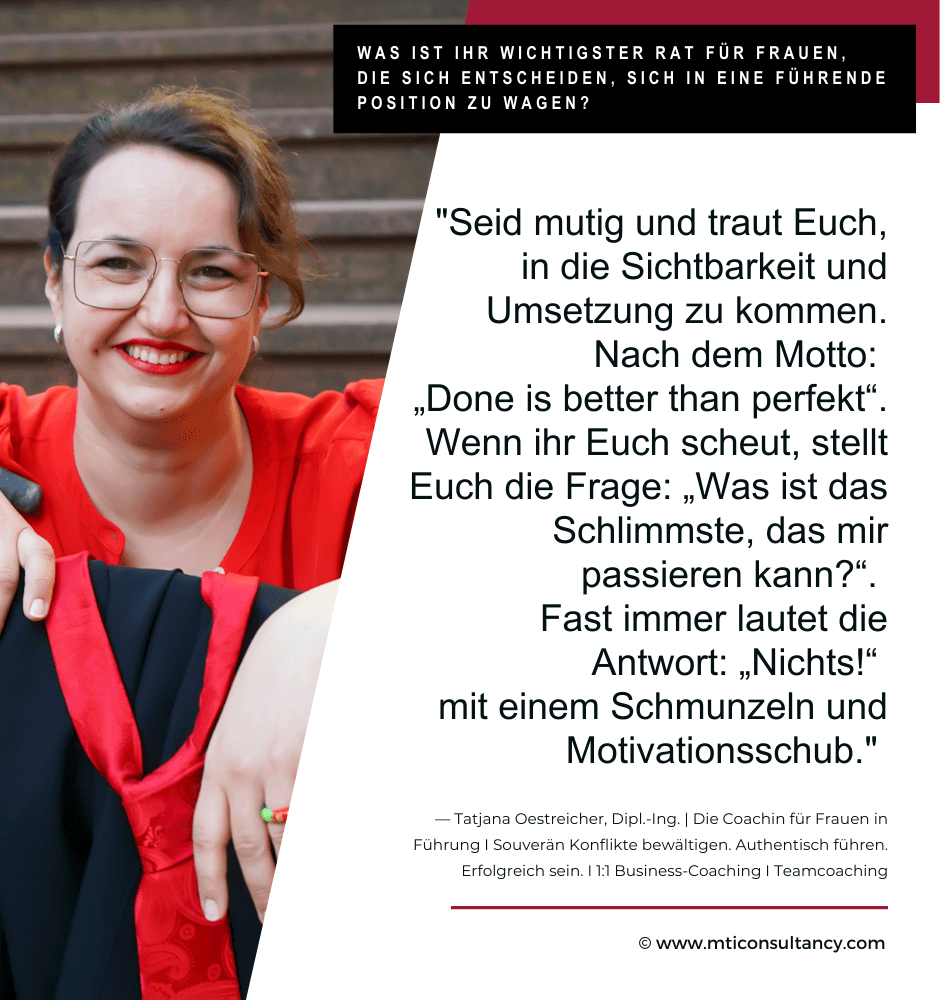
What is your most important advice for women who decide to venture into a leadership position? How do you encourage women?
I would like to take a step back here: many women don't even think of saying or asking: "I want to be a leader!" Why? Because they say to themselves: "Hey! I'm hard-working, I'm conscientious, I do a great job. I'll be asked by my boss if they see me as a leader ." It usually doesn't work out that way! My advice is: "Get into action, be proactive. Without the pressure of having to be perfect or wanting to please everyone. Be courageous and dare to be visible and put things into practice. It doesn't have to be perfect! "Done is better than perfect!" - Just do it.
It is often the fear of rejection. And this fear of rejection, this "doing nothing" slows you down. If you are afraid, ask yourself the question:"What is the worst thing that can happen to me?". The answer is almost always: "Nothing!" with a smile and a boost of motivation.
The chance of taking this wonderful step into leadership is much, much greater if you dare to talk about your ambitions. And if it still happens that your boss says: "No, we don't see you as a leader yet", my advice is always to ask: "Okay, but I want to. What can I do to take the next step? What support programs are available?"
Find a mentor in the company or outside the company. Build up a strategic network. Why do I say "strategic" network? For me, this is something else than just a network. I am deliberately addressing the "man - woman" stereotype. Men are very, very good - if only because of history - at networking and forming networks:"I do something for you, you do something for me!" And it works for centuries.
Cooperation and networking as the key to success
And women do it differently?
Yes, women are much more emotional. And that's why I emphasized "strategic network", because we women - now I'm consciously getting into this "stereotype" again. We women look around us for "Who do I like? Who do I like? Who would I want to meet up with in private?" And "Okay! I like them, I'll add them to my network!" is often the decisive criterion for the choice. The men - and I'm exaggerating a little here - I don't want to say they don't care, but they look at it differently. They think in terms of benefits: "Who will help me achieve my goal?" Women can take a leaf out of their book here. And I mean that in a very respectful way towards men.
I would like to encourage women to not just go by the nose factor - that is also important, of course. But also: "Who can support me in my plans?"
I've made a video about this: "Always on the one - instead of always on the nut!"
This is also part of one of our training programs - 360° Leadership?
Yes, exactly. It's about looking for the number 1 in the company. The number 1 can be a superior, a supervisor, an expert in the organization. Someone with whom a woman knows that he or she will get me ahead. And then it is important to cultivate and use these valuable contacts - in the interests of both sides.
Women in leadership - We don't have to manage everything alone. We can allow ourselves to seek help and accept it
Have you ever encountered obstacles in your career, especially because you are a woman?
Oh yes - there were obstacles! I started my sales career as part of a program for management trainees. At the time, I was the first female salesperson in this company in Germany. I often felt this from my male colleagues: Firstly, I was a management trainee, and secondly, I was a woman! I was watched very closely. And even if I delivered everything perfectly planned, my success was judged differently than that of my male colleagues.
I have also experienced bullying and sexism. "You're only successful because of your bust bonus" and similar phrases. That was really hard for me!
All of these experiences have made me the coach I am today. That's why, from today's perspective, it's totally helpful and valuable for me to have had these experiences. I am able to support women in leadership in a unique way. My clients reflect this back to me time and time again. And that makes me proud!
What have you done to overcome these obstacles and what advice do you have for women in such situations?
At the time, I approached the situations described with a pinch of humor. I made a light-hearted remark and didn't show myself as a victim. There were one or two more attempts like that and then the "attackers" seemed to get fed up. In situations like this, it's important to be self-confident - even if we feel hurt. Just don't slip into the victim role. Instead, keep your composure - above all, this includes self-confident body language. Because if we let ourselves be obviously triggered and react to it, we give our counterpart even more points of attack. And the next line will be cunning.
In other conflict situations, I recommend seeking a personal conversation and confronting my counterpart with the situation. And to take a proactive approach to the conflict.
If these "attacks" do not stop, it is important to get help. We don't have to deal with everything on our own. We can allow ourselves to seek help and accept it.
Conflicts and resistance are at the heart of the most common issues and problems
Are there specific issues and problems that women in leadership face particularly often and that are dealt with in the coaching sessions with you?
Women in leadership come to me when the stress and the associated pain have become great. Much of this revolves around conflicts and resistance of various kinds. There are pain points - I also call them the "Pain!" that a woman leader has with herself. It is about dissolving blockages, developing new beliefs and overcoming resistance.
To come back to the question:"How can women be encouraged to aspire to a leading role in the profession?" - dealing with this question alone can be an emotional rollercoaster: "I can't do it! What if I fail? What will the others think? How am I supposed to manage the balancing act between family and career as a mother? I can't assert myself! I won't be accepted anyway!"
These are internal conflicts or resistances, not necessarily with my external world - only in the second step. In coaching, we often work on taking these thoughts and emotions seriously, analyzing them, working out options for action and finally taking action.
Recently, I have come across more and more dramatic stories in coaching of women leaders who have massive conflicts with their female superiors. I myself also had to go through such a formative experience.
Or if a woman is leader and the deputy is a man. In addition to the fact that the deputy did not apply for the management position. Instead, the former female colleague was promoted and is now his boss. Oh dear, something's up! The man feels cut off or cheated out of a job. Then I often find that the deputies are working against their own superiors.
Or conflicts with employees, conflicts in the team - really everything to do with the topic of conflict is dealt with in coaching.
The balancing act between work and family is often a major challenge for female managers: "How do husband and wife share the home office? Who looks after the children and when? What about the understanding of roles in private life?" - Not only the leadership role, but also the role conflicts at home often resonate.
Who inspires you or has ever inspired you on your own path?
That was my first boss right at the start of my career. When I started as an international project manager at Procter & Gamble after my studies, I was "thrown in at the deep end". My boss was great! I learned about "strategic networking" from her. When I tell my coachees about strategic networking today, I often think of her. She was a lasting inspiration to me.
As a woman, I have had both positive and negative experiences. And my clients benefit from this today.
Women in leadership and the inner drivers
Is there a noticeable difference in the way men and women approach career decisions or career changes?
I like to give an example here that shows that women do tick differently to men. And I'm not singling myself out.
The inner drivers "Do right by everyone!" and "Be perfect!" are often strongly conditioned in women from childhood and are therefore very pronounced - much more so than in men. For men, it is the driver "Be strong!"
The little girl is told by those around her. "Now behave yourself! Have a straight posture! Be nice, kind and pleasing!" As an adult woman, these drivers are often so strong that they block us.
We women need to be aware that you can't please everyone and that you don't have to be perfect. One of my favorite metaphors is the one with the job advertisement: whether internal or external. Let's say a job advertisement has 10 criteria. A man reads through them: "Can I, can't I, can't I, can't I, can't I, can't I..." His conclusion: "Oh, I fulfill two criteria. Wonderful. I'll apply." A woman reacts more like this: "Can I, can I, can I, can I, can I, can I, can I not. I can't do two things and don't meet all the criteria." Conclusion: She doesn't apply.
(smiling) I somehow guessed the outcome...
Why doesn't she apply? Because she feels that she doesn't live up to the standards she sets for herself and others. I work on this mindset really intensively with women in coaching. Building a positive mindset, developing a sense of self-worth, then daring to go for it and growing from your own valuable experiences. That's what I love about my job!
In this context, I would like to talk about the impostersyndrome. This is when a person has very strong expertise, but is afraid to show off their skills. I could make a mistake, could be "exposed" as not being competent enough. This affects both men and women, but women are even more affected by the strong "be perfect" driver. The fear of not being good enough. Or of not doing justice to something or someone.
These people then do hundreds of training courses to cover as many eventualities as possible. However, this is totally unrealistic. It helps to create a mindset for this: "What is realistic, what is not?" And here I come back to the question: "What is the worst thing that can happen to me if I apply for this job? I don't get accepted. Annoying." Now ask yourself the positive question: "What's the best thing that could happen to me? I get the job and have taken my chance. Yeah!"
Women in leadership thanks to the women's quota?
Finally, what do you think about the women's quota?
I used to be against a quota for women. I wouldn't have wanted to be a "quota woman". Today I see things differently. Because the framework conditions for "more women in leadership" are not given or optimal.
Diversity is important to me. I am convinced of the power of diverse teams and organizations. As a team coach, I prefer to work with diverse teams. These teams are very successful!
On the other hand, it is also important to me that there is no pushing like: "A woman has to be in a management position". The women's quota is long overdue and necessary so that the framework conditions for women change and they are perceived more as candidates for leading positions. Skills and leadership still count. No one should be rejected on the basis of their gender or elevated to a position by being forced into a quota. Performance and ability should always come first in any such decision.
Thank you for the great interview and we look forward to more exciting projects with Tatjana.
Inspiring leadership as the key to success
Based on studies on leadership of the future, our 360° Leadership Program teaches managers all the basics and skills they need for a modern, inspiring and effective leadership style.
Tatjana is also part of the MTI 360° Leadership Program trainer team and is responsible for the topic of assertiveness in Module 1.
WE BRING YOUR STRATEGY TO LIFE
Women in leadership often face particular challenges - and this is precisely where Tatjana Oestreicher's coaching comes in. With clarity, empathy and experience, she supports women in overcoming obstacles, developing self-confidence and courageously following their own path. Whether it's conflict resolution, efficient delegation, remote leadership or the balance between work and family - it's always about working on the mindset. Empowering women in management positions not only creates individual success, but also diverse and high-performing teams. If you are considering how the advancement of women and leadership coaching can be effectively implemented in your company, please contact us - together we will develop approaches that have a lasting effect.
You can find out what this can look like here: Case studies & experience reports