
How change drives: Leading in the new "normal"
A few months ago, working under coronavirus conditions was still largely a temporary solution. But it is increasingly becoming the norm. To what extent does this result in new requirements for management? We have put together six theses on this topic:Corona has hit the whole world unprepared. In the private, public and professional spheres, hardly anything will return to the old situation. This brings opportunities and challenges for companies and their managers. Our six theses show why the current situation in the world of work is largely the new "normal".
6 theses on leadership in the new "normal"
Thesis 1:
The coronavirus pandemic has highlighted many existing problems and emerging conflicts.
In other words, it was not their cause. It merely acted as a magnifying glass that made deficits and omissions more visible.
Thesis 2:
Most of the challenges that managers are currently facing already existed before the pandemic. However, managers often did not face them.
For a wide variety of reasons. Be it because they were working at their limits. Or because they lacked the necessary support from above. Or because this would have required them to throw cherished routines overboard and enter into conflict with their employees.
Thesis 3:
Many a change would have made sense even before the crisis.
For example, the further development of the company's own management style due to the changed framework conditions in the VUCA world. Or digitizing some of the services. Or rethinking the form of collaboration.
Thesis 4:
The companies that were already facing up to the issues relevant to the future before coronavirus are currently in a better position.
They can react more quickly to the new framework conditions - also because their team has internalized the "life means change" mindset "top-down" and has already gained experience in tackling and mastering new, complex challenges.
Thesis 5:
The best time to start making the necessary changes is now.
Also because it is currently easy to communicate to employees: "Something has to change, because...."
Our reading tip on the topic:
The corona effect: 4 future scenarios for the economy and society
How will the pandemic change our lives and economies? The Zukunftsinstitut describes four possible scenarios for how the coronavirus crisis could reshape the world.
You can download the complete white paper with detailed explanations of the individual scenarios here.
Tackling change
Change begins as an altered pattern of expectations, perceptions and connections to the world. Sometimes it is precisely the break with routines, the familiar, that frees up our sense of the future. The idea and certainty that everything could be completely different - even for the better. Whether change is caused by crises or brought about by the changing times, companies and employees go through various phases of change and emerge stronger in the final phase (with the right change management) after initial rejection and frustration (see illustration).
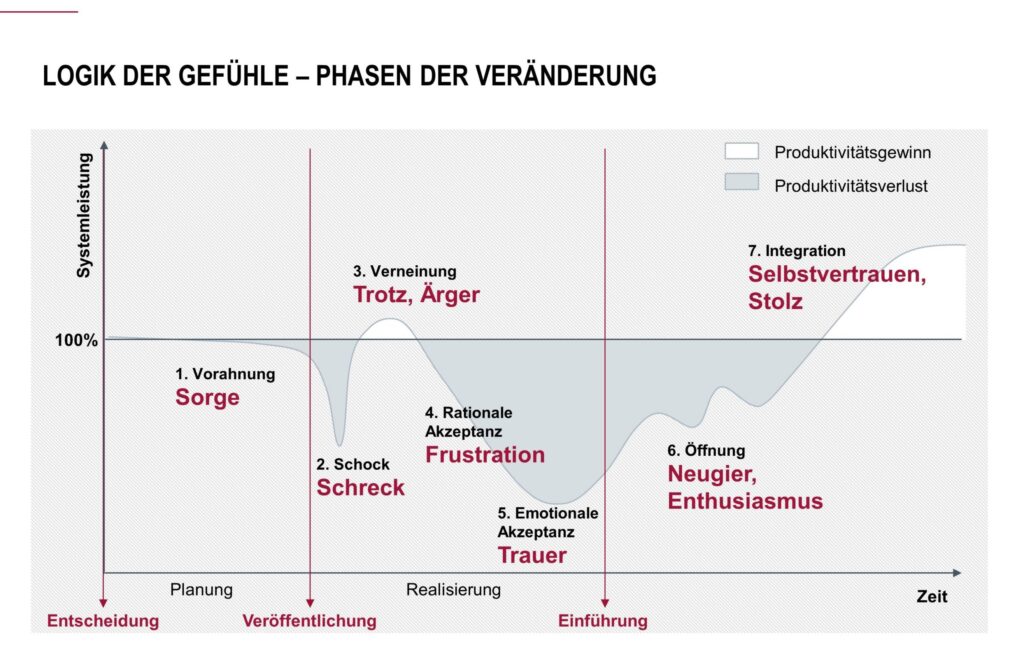
Phases of change according to Streich
Streich developed the 7-phase model, which depicts the emotional development of employees - starting with the anticipation and shock when changes are announced and ending with the adoption of new thought and behavior patterns in everyday working life during implementation.
Change as an opportunity for everyone
The corona crisis and the changes it has accelerated are an opportunity for everyone: after a period of bewilderment and fear, an inner strength for a new beginning is emerging. Companies that want to tackle change need to analyze their starting point...
- What blind spots and cultural patterns prevent us from breaking new ground?
- What motivates you to dare to try something new and go further?
...and develop their strategy from this:
- In which areas are there changes?
- What is the current situation?
- Where do we need a reorganization?
- What decisions need to be made?
Managers must now always act strategically in order to drive development forward. New Work and transformational leadership now form the framework for future developments.
Read our detailed article, including an interview with Hans-Peter Machwürth, for more information on leadership in the new "normal".
WE BRING YOUR STRATEGY TO LIFE
Leading in the new normal means no longer seeing change as an exception, but as an integral part of everyday working life. The coronavirus crisis has highlighted existing problems and shown that traditional routines are no longer enough. Companies that focused on digitalization, agile collaboration and modern leadership styles early on are now at a clear advantage. Now is the right time to rethink leadership, question routines and actively shape change. MTI supports you with professional coaches and practical concepts - so that your company emerges stronger from the new normal.
You can find out what this can look like here: Case studies & experience reports