
Value based selling - selling better through value propositions

Giving customers a value proposition and delivering on it: Value Based Selling as a new sales approach - the project report on (online) sales training in the New Normal
At the beginning of 2020, the Sartorius Group was planning a classroom-based training program for sales employees in the Bioprocess Solutions division. But then came Corona! Are we canceling the program? What challenges does the project now face? It quickly became clear that training is of great importance, especially in these times - so our joint program was converted into a blended learning program with synchronous and asynchronous learning units. This even turned out to be a lucky coincidence, as shown by the fact that the program was awarded the BDVT training prize.
The Sartorius Group is a leading international partner to the biopharmaceutical research and industry with more than 14,000 employees worldwide. At the beginning of 2020, the company decided to plan a new, global training program for its Bioprocess Solutions Division sales employees based on a uniform sales approach. The objectives of the development measure, in addition to even greater market penetration, were as follows

Originally planned as a hybrid training program
A project group was commissioned with the task of planning and implementing such a training program. The project sponsor was the Head of Sales & Service of the Bioprocess Solutions division, Bettina Berendsen, and several senior managers as the steering committee; in addition, several members of the core team, which is made up of managers from various levels of the sales organization, as well as our trainers Susi Graham and Gilles De Groot.
Because the development program was planned to be hybrid, it was important for the customer that we as a partner also operate internationally and have decades of experience in designing such programs and rolling them out worldwide using modern information and communication technology. The sales training should therefore
- learning in groups and in self-learning phases and
- learning in face-to-face events and online learning
be linked with each other in order to strengthen communication and the exchange of experience between sales employees across countries and cultures.
Determining requirements with a system
It was clear to the project team that in order to achieve the project goals, they needed to know the specific needs of the target group. For this reason, interviews were first conducted with relevant stakeholders in the sales organization and with customers - across functions and divisions. In addition, a benchmarking assessment was carried out with 670 sales employees to identify their development needs and potential. This also included a comparison of the strengths profile with that of sales employees from other companies.
As the results showed, the Sartorius sales team is strong in the areas of change management and adaptation to changing conditions and requirements, as well as in recognizing sales opportunities. However, there is still potential for development in
- Demonstrating the added value of Sartorius products and problem solutions for target customers,
- efficient and effective processing of the respective business opportunities and
- Guiding customers to the purchase decision
It was also found that there is no uniform understanding of the most important steps in the sales cycle. The local organizations and key stakeholders described the sales cycle very differently. Although there were best practices, these were not communicated enough to colleagues. This was also due to the fact that the specialists for applications and product families only saw themselves as part of the sales team to a limited extent and therefore did not feel sufficiently responsible for sales success.
Based on the results of the needs analysis, the following learning and development objectives were defined for the training program:
- Global harmonization of the sales approach towards a value-oriented approach
- Sensitizing participants to the fact that the entire team is responsible for sales success
- Stronger international networking and a more intensive exchange of experience
- Greater effectiveness of customer meetings thanks to increased teamwork and cross-functional preparation
- Cross-functional and interdisciplinary learning
- Practicing a communication style that builds a bridge from benefit to value for the customer
- Developing value-added sales stories based on the needs, history, (development) goals, etc. of the respective customers
Based on this, the rough concept for the "Sales Enablement Program" was developed and approved by the Steering Committee. The program was then to be developed. However, due to the travel and contact restrictions in place from spring 2020 as a result of the coronavirus pandemic, the training program could not be carried out in the planned form.
The project team:

Susi Graham, Hans-Peter Machwürth, Gilles De Groot, Ines Rannenberg
Corona forced us to rethink - cornerstones for the New Normal
For a short time, the project team considered stopping the program. However, regardless of the pandemic, the program is an important support in achieving the growth and development goals. It was therefore decided to implement the originally planned hybrid sales training with face-to-face components as a blended learning training program. In addition to joint web sessions, this also included independent self-study phases.
The learning management system ILIAS and MS Teams were used as technical aids, as well as digital tools such as the concept board and several of our MTI tools for digital moderation and feedback. By receiving participant feedback on the web sessions and the self-learning material, such as explanatory videos, readers, podcasts, etc., these were further optimized where necessary.
Although this meant extra work for everyone involved, a blended learning format made it possible to carry out the sales training despite the pandemic and respond quickly to new requirements. It also made it possible to form cross-national and cross-cultural learning groups, which promotes global exchange between colleagues.
The brief and regular interventions ensure sustainable learning, as thought-provoking impulses and learning impulses are repeatedly interspersed into the ongoing sales processes in a situational and needs-oriented manner. According to Ines Rannenberg, this type of learning design also represents the start of a new learning culture at Sartorius.
The facilitators and learning guides are qualified
In addition to the MTI project employees known as "facilitators", the "program champions", i.e. experienced Group sales employees, were prepared for their task in parallel with the development of the training program. They were to act as learning guides and supporters for their colleagues as well as process moderators in the sales training program. According to our consultants Susi Graham and Gilles de Groot, this was important because the remote delivery of learning content and online feedback posed new challenges for everyone involved in the project. In addition, Sartorius' requirements for the overall project were as follows:
- Learning in the Sales Enablement Program is based on real tasks and practical cases in everyday sales.
- There should be a regular, cross-functional exchange about what has been learned and joint preparation for the next web session in the learning groups.
- What is learned in the web sessions is to be applied directly in the real management and sales process as well as in real employee and customer contact.
- The aim is to stimulate participants' self-regulated learning in order to strengthen their personal responsibility.
The first roll-out phase of the 13-week "Value Based Selling Fundamentals" training program began in February 2021. The training concept was tested in practice with several pilot groups in a pilot project. This phase also served to test the extent to which the modified program meets the real requirements of everyday working life and the identified development needs of the participants before the large-scale roll-out.
The practical test showed that the program works. The second roll-out phase therefore began in September 2021, involving the entire sales team in the division.
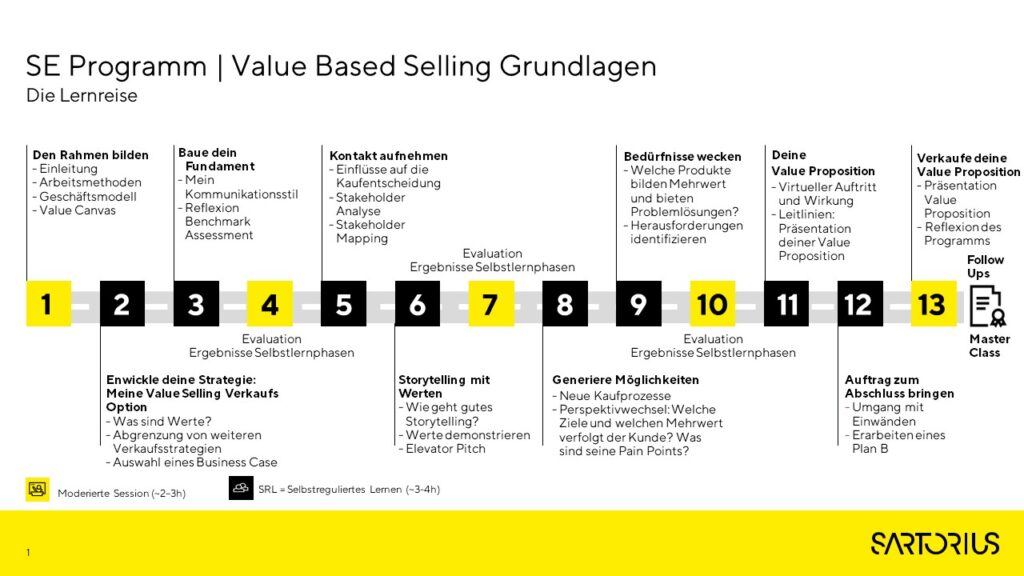
Learning based on real tasks in everyday sales
The concept and working methods of the training are exemplified in the 11th to 13th week of training. Here, the participants are expected to bring together the knowledge they had acquired in the previous weeks. From the outset, they were divided into learning teams consisting of sales employees, technical specialists and managers. The teams were given the task of preparing a sales presentation for a real customer in several process steps, based on a "value proposition" that they had defined in advance in relation to the respective customer.
According to Susi Graham, this is a challenging task because the promises must, of course, also be kept - so they must have a solid foundation. Therefore, formulating a viable value proposition requires knowing the customer's real needs in terms of their market situation, (development) goals, etc. - only from this can you derive what represents real added value for them. Determining this is not easy, especially in a market situation where you can only communicate with customers by phone and online.
Raising awareness of customer needs
In addition, there are two further complicating factors, as our consultant Gilles de Groot emphasizes. Firstly, the buying decision process for Sartorius products usually involves several people and departments on the customer side, some of whom have different expectations of the "problem solution". The development of a value proposition therefore also requires a dialog with the customer to determine which people are involved in the buying process and what their specific benefit expectations of the product are.
The second complicating factor is that customers' benefit expectations are constantly changing. Or to put it another way: The importance that customers attach to various factors in their purchasing decisions is changing. During the pandemic, for example, the factors of delivery capability and security have become much more important for many customers. Therefore, especially in times of rapid social and economic change, sales employees must regularly check whether the formulated value proposition still meets the customer's needs or whether their purchasing decision criteria have changed in the meantime.
Senior managers slip into the customer role
In the 13th week of training, the learning teams created an online sales presentation based on the preparatory work. At the end, they presented this to members of top management. During the presentation, they slipped into the role of the customer, so to speak, who also asked critical questions and formulated objections. This marked the end of the second roll-out of the sales training in December 2021.
The intensive training phase was followed by a follow-up to ensure that the knowledge and skills acquired were not only firmly anchored in the minds of the participants, but also in their actions. Since then, the program participants have been working on sales-related topics defined by themselves in learning groups based on their needs and functions and regularly share their experiences online. Value Talks are also held regularly. At these online meetings, sales professionals share their experiences such as best practice and lessons learned. Members of the Core Team and Program Champions are also part of this discussion group to promote cross-hierarchical exchange.
In the meantime, participants should also receive regular learning nuggets on sales-related topics as learning impulses. This ensures that skills are further developed in line with the company's objectives and current market requirements.
Roll-out of sales training to other areas
The success of the program is measured during the process by specifically evaluating and communicating the success rate of the value-based selling concepts developed during the training for specific customers. Key indicators such as the closing rate, sales development and customer satisfaction are also recorded.
Participant feedback on the web sessions was and is also an important management tool. They are specifically evaluated according to the extent to which the design of the training and its content meet the needs of the participants and the objectives of the company.
In summary, it can be said that the Sales Enablement Program was and is a complete success. In addition to the sales performance indicators mentioned above, this is also demonstrated by the sales deals closed with the customers that were processed as practical cases during the training. According to Ines Rannenberg, this makes the Sales Enablement Program one of the most successful training programs and global projects that the Bioprocess Solutions division has carried out to date. This is the reason why the Sartorius Executive Board decided in summer 2021 (i.e. after the pilot training sessions) to implement the program in the Lab Products & Services Division in 2022. This is now the case.
What is the recipe for success?
The key success factors of the Sales Enablement Program were and are
- the "co-creative conception process" in program planning with the Sartorius Core Team and members of global senior management,
- Involving and preparing in-house experts, the so-called Program Champions, to support the participants,
- Involving managers in the practical transfer of what they have learned,
- the concept of social learning: learning from each other, for each other and with each other
Sartorius cites the fact that the participants in the Sales Enablement Program embark on a learning journey with short interventions and independent self-learning phases, in which the motivation to learn always remains high due to the active design using role plays, group work, collegial feedback, etc., as further success factors. In addition, the relevance of what was learned to everyday working life was and is always clear thanks to the work on specific practical cases. All these factors contributed to the fact that the program was a success from both the participants' and the company's point of view and at the very least laid the foundations for a new learning culture in the division.
WE BRING YOUR STRATEGY TO LIFE
Selling with value - sustainable success. Value-based selling means giving customers a clear value proposition and delivering on it. This creates trust, long-term relationships and measurable success in sales. If you are considering how a value-based approach can strengthen your sales performance, please contact us - together we will develop concepts that have an impact.
You can find out what this can look like here: Case studies & experience reports