
Transformational leadership in the cultural change of VUCA, Industry 4.0 and digitalization

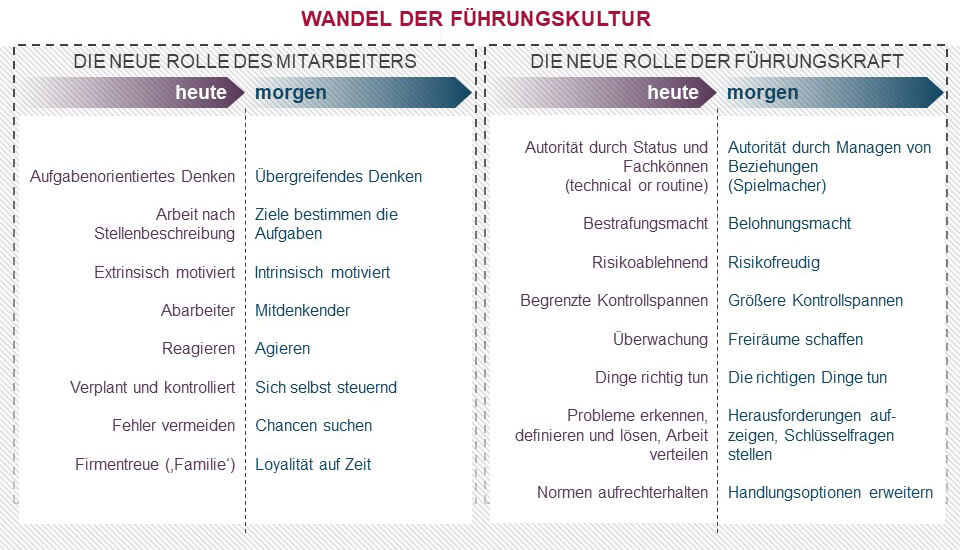
An increasing pace of environmental change, growing complexity and a shortage of resources are leading the trends in the context of leadership and presenting management with new challenges. The architecture of companies is also changing - the focus is on process and value creation orientation, decentralization of decision-making processes, self-control and continuous improvement. This means that the basic attitude of leader must also undergo a change.
Basic attitudes to leadership as a consequence of trends
Accepting development trends
- Openly recognizing and affirming development trends and change processes instead of negating, resisting or opposing them.
- Manage development trends: take up the positive approaches and energies contained in the changes, understand them as an opportunity and allow them to take effect
- Tracking down and engaging with the changing demands on leadership resulting from trends.
Focus on personal responsibility
- Trust in the ability to shape the future. Do not see the future as an unchangeable fate to which you are idly and resignedly exposed.
- Recognizing the concrete co-responsibility and personal initiative for this future.
- Trust in other people's willingness to take responsibility, creative drive and participation.
- Recognizing and developing the energy and potential of employees.
Permanent willingness to learn
- Questioning one's own attitudes, thought patterns and ideas about other people and areas.
- Accepting the subjectivity of one's own opinion, accepting other points of view and mentalities.
- Willingness to correct one's own behavior and actions, giving and receiving feedback.
- Positive error mentality: Allowing yourself and others to make mistakes from which you can learn.
- Understanding leadership itself as a constant search and learning process.
Transformational leadership
The high external pressure to change in the corporate environment therefore causes greater internal insecurity due to the feeling of loss of control. The leader is now called upon to strengthen the self-concept and thus the performance potential of employees by contributing to this,
- that your team deals constructively with the future and develops its own orientation.
- that everyone takes personal responsibility and shapes their role.
- that stable relationships of trust are established that are emotionally sustainable.
- to continuously develop and promote the potential and skills of employees.
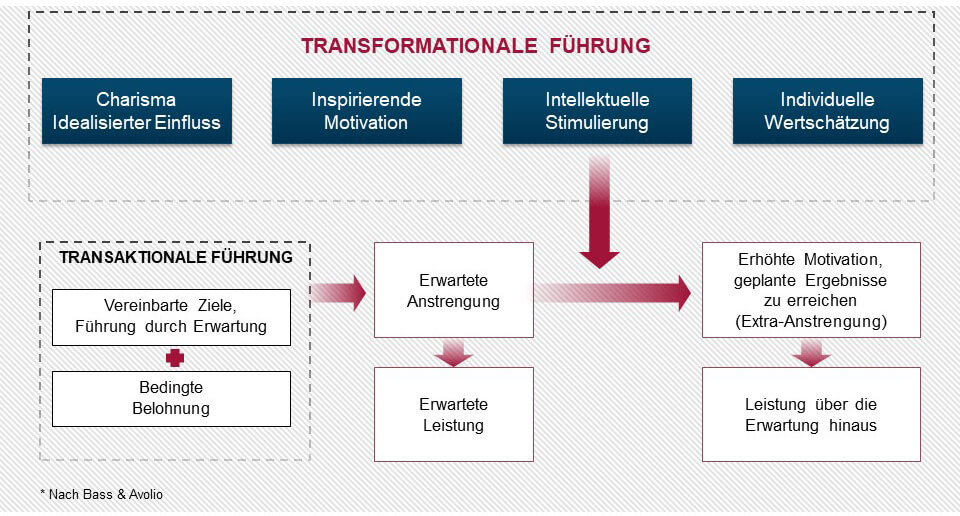
In the TL concept, the personality of a leader is very much to the fore. Their most important characteristics include charisma and the ability to win over and inspire other people for themselves and for specific goals. The status of this leader is based less on power and position in the hierarchy and more on trust and personal commitment.
The leadership concept of transformational leadership (TL) emerged back in the 1990s and is characterized by features that, at first glance, should be ideally suited to meet today's requirements in the world of work. According to the TL philosophy, a manager largely refrains from issuing instructions, directly influencing behavior or leading exclusively via target agreements (transactional). Instead, their leadership actions are aimed at changing employees' attitudes, behavior and awareness. Leadership for self-leadership is the best way to translate this concept, which originated in the Anglo-American world.
The leadership style of transformational leadership is extremely participative, and those being led are given plenty of scope and freedom to make decisions in order to achieve their goals. Goals only provide the general direction, but not the way in which they are to be achieved.
The leader sees himself as a coach for his employees. They also try to stimulate their leaders intellectually, for example by showing them ways in which problems can be seen in a new light. He creates appropriate challenges and encourages innovation and creativity.
The future of leadership - The tasks of the leader
One of the most challenging tasks is the individual development of those being led. The leader recognizes the specific skills and needs of their employees. On the basis of individual appreciation, she advises, encourages and supports the leaders whenever necessary.
While transactional leadership in the instrumental sense brings about and rewards expected performance, transformational leadership mobilizes the potential and skills of employees, which make up that certain 'extra' that gives companies a competitive edge. Transformational leadership is therefore a consistent further development of transactional leadership or leadership with target agreements (good performance is "rewarded" and recognized, undesirable performance is "punished"). Concepts of cross-generational leadership, agility and blended workspace are based on the successful implementation of transformational leadership in practice.
The development of an appropriate leadership culture is therefore a key challenge and task for companies today. It can only be implemented as an overarching process of organizational development that puts structures and processes, mentalities and attitudes, behavioural patterns and relationship qualities to the test and changes them.
WE BRING YOUR STRATEGY TO LIFE
Leadership in transition - trust instead of hierarchy. In a world shaped by VUCA, Industry 4.0 and digitalization, it is no longer enough to lead purely transactionally via target agreements. Transformational leadership relies on charisma, inspiration and personal commitment to empower employees to lead themselves and take responsibility. Managers become coaches who promote creativity, develop individual strengths and mobilize teams through appreciation and trust. This creates a culture that not only copes with the external pressure to change, but also gives companies a competitive edge. If you are thinking about how you can future-proof your management culture, please contact us - together we will develop solutions that have an impact.
You can find out what this can look like here: Case studies & experience reports