
Social sustainability in manufacturing companies
On April 13, 2023, the working group "Ecologically and socially sustainable production" met as part of the transformation network neu/wagender Region Hannover/Hildesheim at a manufacturing company that is known worldwide for the production of starter batteries for cars and trucks. The second working meeting focused on social sustainability. With a presentation by Managing Director Hans-Peter Machwürth and consultant Jacqueline Pojer, MTI was able to provide impetus and insights into the various aspects of employee life cycles in companies and stimulate discussion.
The neu/wagen project, sponsored by the Hannover Region, is funded as part of the "Transformation Strategies for Regions of the Automotive and Supplier Industry" directive of the Federal Ministry of Economics and Climate Protection (BMWK). The Hannover Region has commissioned the Institute for Process Engineering, Energy Technology and Climate Protection at Hannover University of Applied Sciences and Arts with the organization and scientific support of the working group.
Three factors of sustainability
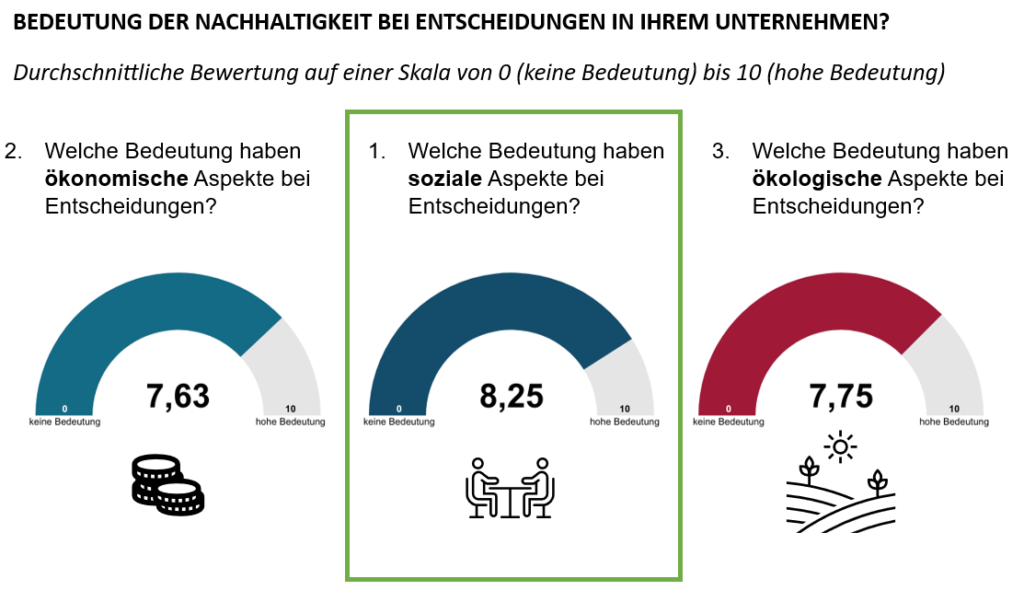
A survey of the working group participants conducted during the presentation on the weighting of sustainability factors revealed that social sustainability has a high priority in business decisions:
Fundamentals of social sustainability
Social sustainability is one of the three pillars of sustainability and consists of five fields of action:
- Consideration of the needs of employees
- Support in the development of personality
- Respectful interaction with the local environment (residents and municipalities)
- Take project initiatives in the above-mentioned areas and expand them in the long term
- (Financial) support for foundations, associations, etc. with activities in the social, cultural or educational field
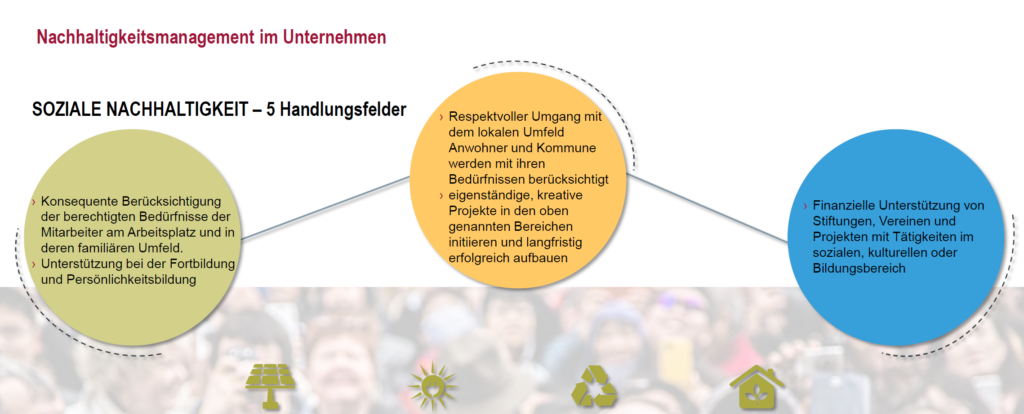
Specifically, social sustainability involves social action at various levels.
- Health and safety for employees and the environment
- Labor and social standards for the entire supply chain
- Further training, personnel development and diversity management
- Stakeholder management
- Socio-cultural, community involvement
- Informative communication with suppliers and customers
Sustainable procurement and employee retention in production
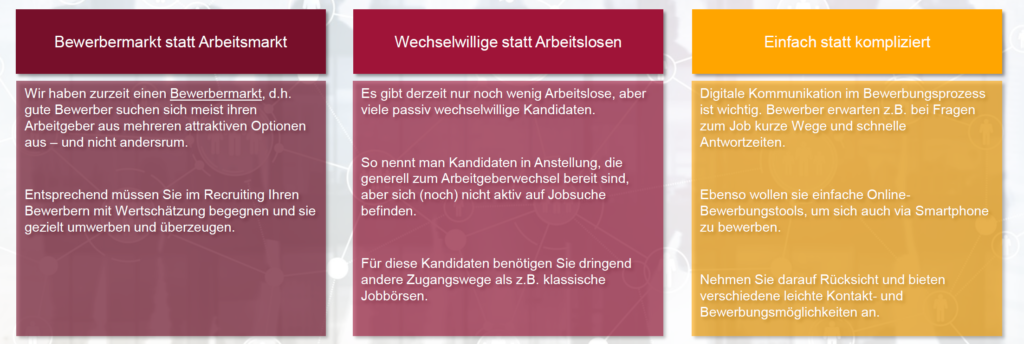
The development from a labor market to an applicant market began years ago and presents companies with new challenges.
- Companies compete for applicants, not applicants for employers
- Low unemployment rate and passive switchers
- the old familiar application processes are no longer up to date
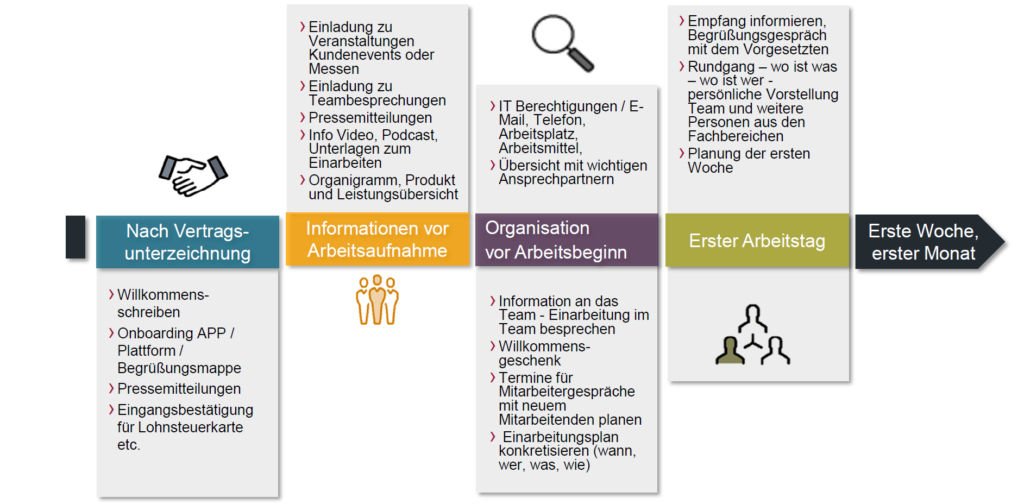
Modern onboarding
A well thought-out onboarding process not only helps the organization to regulate new hires, but also helps new colleagues to feel like a fully integrated and enriching team member and to become a satisfied employee.
The graphic below illustrates what successful onboarding can look like.
Employee retention - what modern leadership can achieve
What is inspirational leadership?
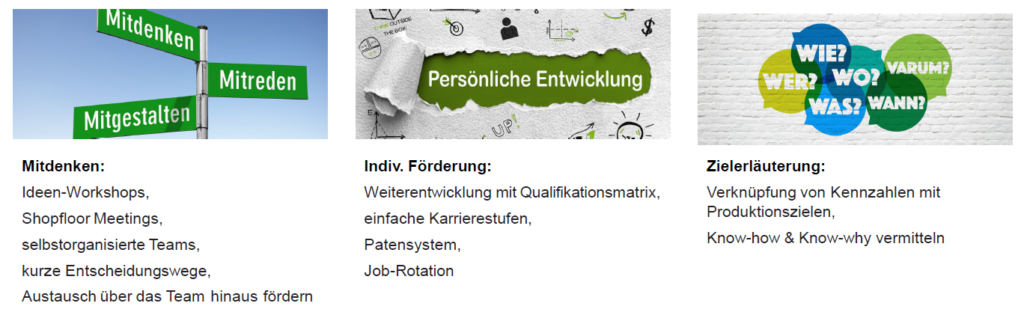
Inspirational leadership focuses on giving meaning and an attractive image of the future - the vision - so that employees recognize the "why" in their work. It is also characterized by the consideration of relationships and values and aims to address employees individually and emotionally beyond the purely factual level.
Managers ask for ideas and solutions, present a vision/strategy/goals/why, set team goals, challenge and encourage their employees individually, set challenging goals and provide continuous feedback.
As part of modern leadership, the inspirational leadership style has a demonstrably positive effect on the following aspects:
- Capacity utilization
- Productivity increase
- Employee fatigue and absenteeism
- Employee commitment and retention
Examples of tools for inspiring leadership in production:
During the subsequent factory tour, the participants of the working group experienced how two trainees explained the production process with dedication. Sustainability issues such as employee health, renewable energies, climate protection measures and, for example, a 99% recycling rate for used batteries played an important role.
During the event, the organizers and company representatives agreed on specific topics to be explored in greater depth in the subsequent working groups. In addition to technology-oriented topics such as renewable energies, a possible training concept to raise knowledge and awareness of the various aspects of sustainability among managers and employees was also identified as an important project to be explored in greater depth.
Actively shaping social sustainability
MTI project examples that contribute to social sustainability:
- Healthy leadership (BMW, Miele)
- 360° Leadership Training (Fima Maschinenbau, Ruhrpumpen)
- Management feedback (Deutsche Bundesbank, Volkswagen Financial Services)
We would be happy to share the details of these and other project references with you.
Feel free to contact us!
WE BRING YOUR STRATEGY TO LIFE
Sustainability works - ecologically and socially. We support companies in assuming responsibility throughout the entire employee life cycle and firmly integrating social aspects into production processes. This creates an interplay between employee health, climate protection and innovation that ensures future viability. If you are considering how social sustainability can be anchored in your organization, please contact us - together we will develop approaches that have an impact.
You can find out what this can look like here: Case studies & experience reports