
MTI study: Business coaching in personnel development - facts, figures and data

Our latest study has shown: A change in the function of coaching is currently taking place in companies - partly because their HR developers are discovering the benefits of digital technology for their work.For our study "Importance and organization of business coaching in HR development", we surveyed 492 employees from companies with more than 50 employees using two partly different questionnaires; including 127 employees from banks and insurance companies. Of those surveyed, 74 percent were potential coachees, i.e. coaching participants (questionnaire 1), and 26 percent were HR managers (questionnaire 2). The survey took place in fall 2020. The results of the study therefore already included experience from the coronavirus period.
Coaching is an established personnel development tool
The study revealed that although coaching is now an established HR development tool in companies, particularly in service companies such as banks and insurance companies, the perception of its importance varies. For example, 75 percent of HR developers emphasized that coaching already has a high status in their organization and that its acceptance is high. Among coachees, however, the figure is only 50 percent.
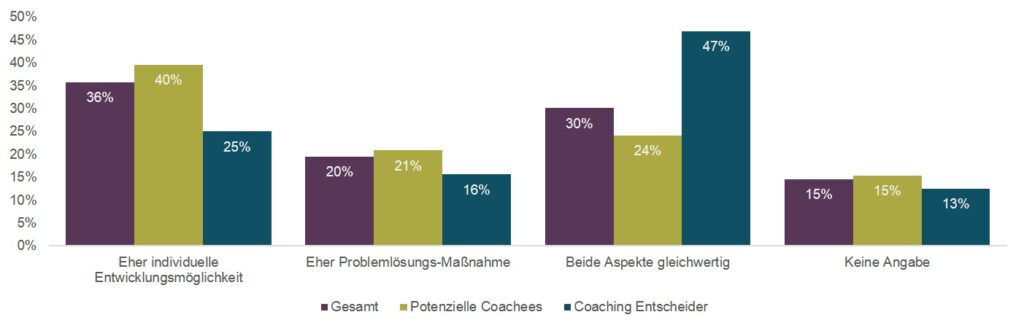
The function of coaching is also viewed differently. For example, 40% of potential coachees see coaching primarily as an individual development measure and 21% as a problem-solving measure. However, only 24 percent attribute both functions to coaching. Among personnel developers, this figure is almost twice as high: 47 percent.
Individual coaching sessions - primarily for managers - dominate
In most companies, coaching is still primarily aimed at managers. By contrast, only 34% of those surveyed emphasized that their company offers coaching for all employees - regardless of their function and hierarchical position. In the case of financial service providers, this figure is as high as 36 percent. Specialists also rarely benefit from coaching.

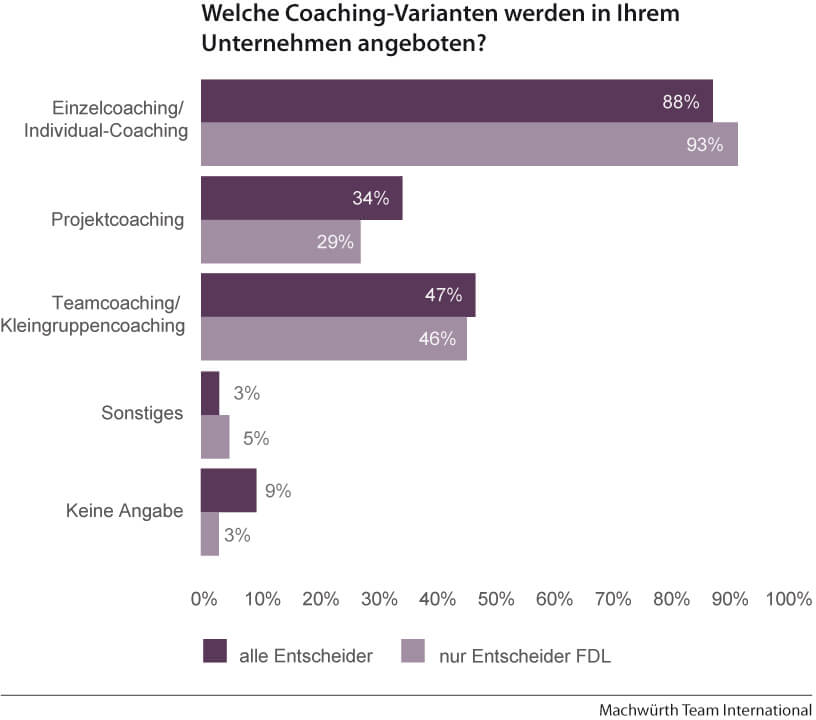
With regard to the forms of coaching used, it is striking: Individual coaching sessions are not only offered by far the most frequently in companies, they are also the most frequently used from the perspective of potential coachees (79%). The situation is different for team, small group and project coaching. Although team coaching is offered in 47% of companies, only 33% of coachees indicated a need for it. Regardless of this, the majority of respondents are convinced that the importance of small group coaching (41%) and specialist coaching (34%) will increase.
Currently, 56% of respondents answer the question about the reason for coaching: The typical reason for coaching is development and support measures - often after feedback and target agreement meetings with employees (financial service providers: 61%). These coaching sessions are generally likely to be individual coaching sessions. Less frequently, however, coaching is provided in conflict situations (20%) or for acute problems (18%). These coaching sessions are more likely to be team coaching sessions, as they usually also relate to collaboration.
The top topics are still leadership and conflict management
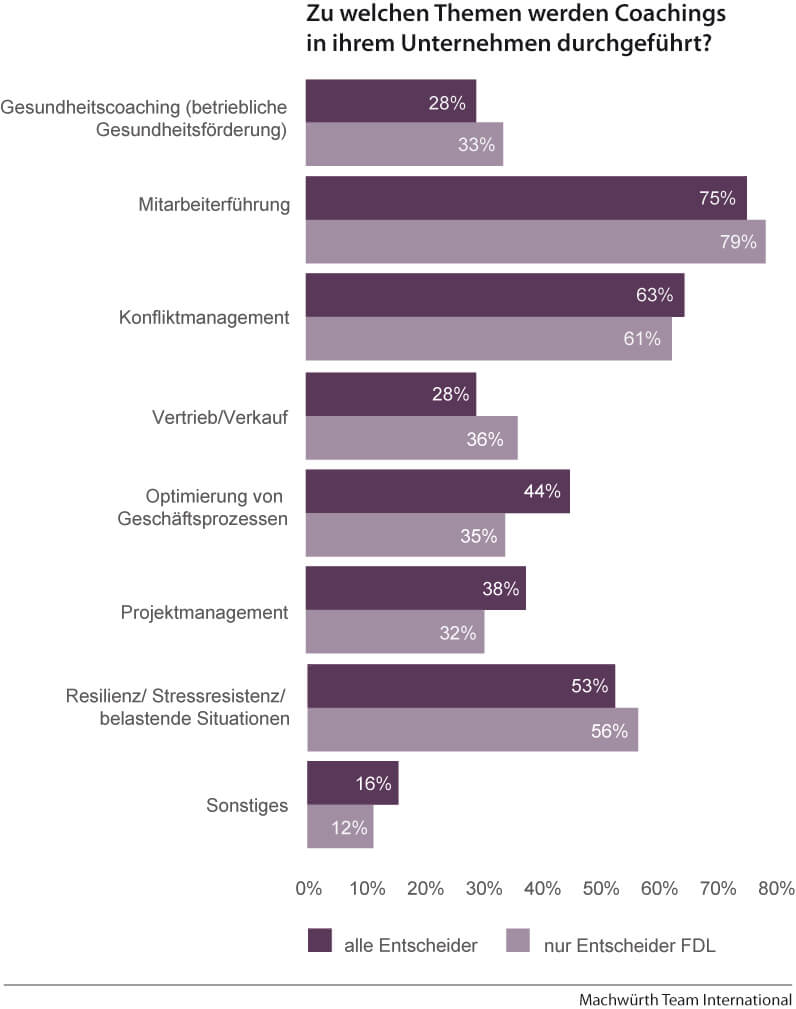
The top coaching topics from the decision-makers' perspective are "employee management" (75 percent) and "conflict management" (63 percent). Only in third place (53%) is the absolute top topic for decision-makers from the perspective of potential coachees (58%): "Resilience, stress resistance, dealing with stressful situations".
With the exception of sales, remarkably few companies across all sectors offer coaching with a clear connection to business - for example on the topics of "optimizing business processes" and "project management". It is also striking that the coachees signal a significantly lower need for these than the personnel developers.
During the survey period, 25 percent of decision-makers stated that their company supports coaching with digital tools such as a learning platform (financial service providers: 34 percent). Overall, only 9 percent of coachees agreed with this statement, compared to 16 percent of banks and insurance companies. This finding can possibly be explained by the fact that many HR development departments only took significant initiatives to set up a corresponding technical infrastructure after the coronavirus lockdown. However, this is probably only currently being used for selected target groups - for example, employees working from home.
Telephone and online coaching are on the rise
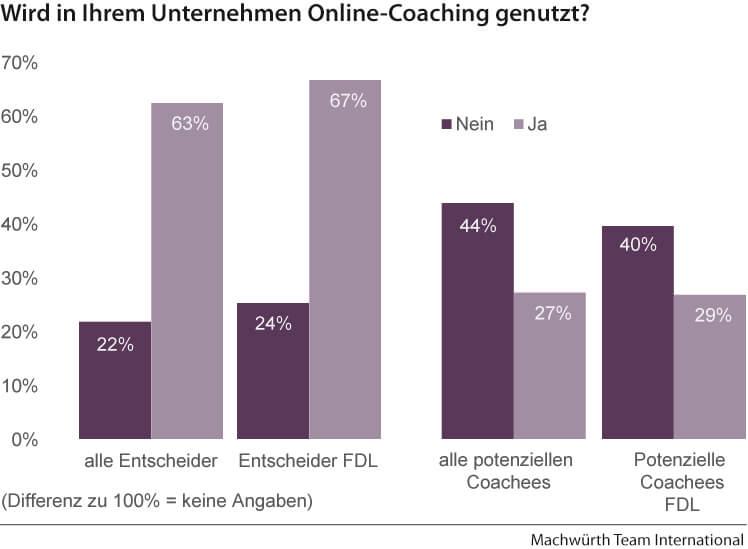
The same applies to online coaching. In September/October 2020, almost two thirds of decision-makers said that it was also used in their organization; of the coachees, only one in four agreed with this statement. This also suggests that although telephone and online coaching is increasingly taking place in many companies as a result of coronavirus, only part of the workforce has been covered by this so far. This is likely to change in the near future, as telephone and online coaching is currently also becoming a standard tool in the financial services sector and is increasingly being integrated into personnel development processes.
HR professionals and line managers usually still take the initiative
In most companies, the coaching initiative rarely comes from the coachees. For example, 54% of those surveyed stated that coaching sessions are initiated by HR Development on an ad hoc basis. In addition, 46% say that the respective line manager requests coaching sessions for their employees. In 63% of coaching sessions, the coach is also suggested by HR Development.
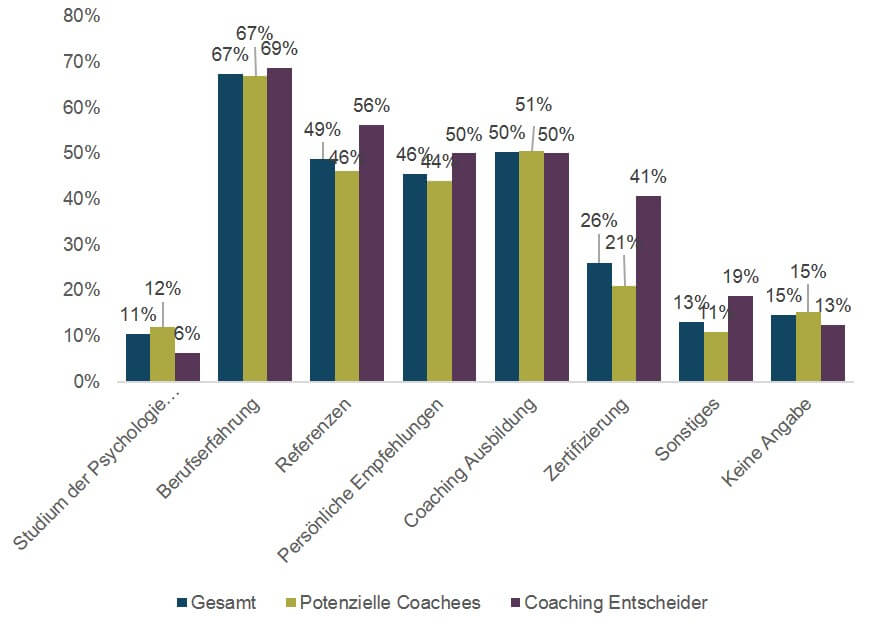
The most important criteria for the selection of coaches for HR developers and coachees across all sectors are professional experience (69% and 67% respectively), existing references (59% and 46% respectively) and whether the candidate has undergone coaching training (50% and 51% respectively). However, personnel developers are significantly more likely than coachees to attach importance to certification (41% and 21% respectively).
Coaching processes are usually not yet evaluated
Almost 60 percent of decision-makers say that their company has a standardized process for planning and implementing coaching measures. Less than 30 percent of potential coachees agree with this statement - possibly because they are not familiar with the process.
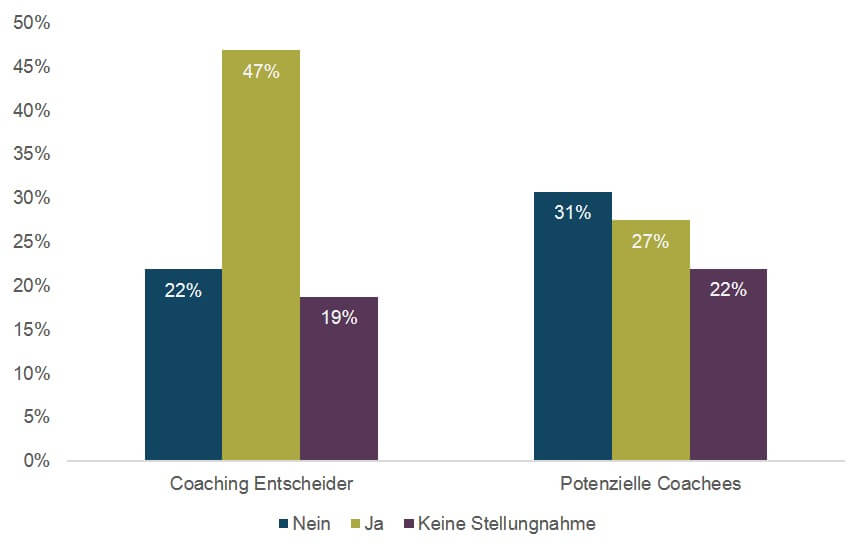
It is also striking that 47% of HR developers state that coaching sessions are evaluated in their company. However, only 27 percent of potential coachees confirm this - possibly also because the specialist departments are not familiar with the day-to-day work of HR developers in the staff departments. However, the fact that not even half of the HR developers at financial service providers say that coaching is evaluated in their companies indicates this: Coaching is often not yet seen as a central component of strategic HR development that is geared towards defined and measurable goals.
Conclusion: Coaching is currently undergoing a functional change
The results of the study can be summarized as follows: Coaching is an established instrument of personnel development in companies; however, it is still rarely understood as an instrument of organizational development. As a result, it is generally used across all sectors to remedy deficits on an ad hoc basis rather than strategically. In addition, coaching measures are rarely evaluated systematically.
This means that coaching is still primarily seen as an individual support measure and less as a team development measure and a tool for achieving business goals. Accordingly, the focus of coaching is currently still mostly on so-called "soft topics" such as leadership, communication and self-management, as well as interpersonal topics such as conflict management and collaboration. Coaching is rarely used for business topics such as project work, strategy implementation and cultural change.
However, a rethink is currently taking place across all industries, including in the context of the discussion on how companies can increase their agility or make themselves "fit for the future". Overall, there is a tendency for coaching to be seen less as a tool for remedying personal and organizational deficits and more as a tool for systematic skills development, quality assurance and achieving business goals. For this reason, coaching services are increasingly being extended to employees without management responsibility, particularly in service companies, and team and project coaching is also gaining in importance. In addition, in connection with the New Work debate, topics such as collaboration, work and self-organization are coming more into focus.
We believe that this development has been accelerated by the coronavirus pandemic. As traditional HR development measures such as face-to-face seminars and coaching have only been possible to a very limited extent since the outbreak, many companies, including those in the financial services sector, have discovered the opportunities offered by modern information and communication technology in the area of HR development in recent months. In addition to telephone coaching, online coaching is also benefiting from this, having led a rather shadowy existence until the outbreak of the pandemic. This is currently developing into a standard tool for HR development - even if many companies are still busy setting up the necessary infrastructure.
WE BRING YOUR STRATEGY TO LIFE
Our MTI study shows: Business coaching has long been established, but is still often seen as a purely individual measure. The focus is on topics such as leadership, conflict management and resilience, while digital formats such as online coaching are becoming increasingly important. There is a clear trend towards using coaching more strategically - for teams, employees and to support business goals. If you are considering how coaching can strengthen your HR development, please get in touch with us.
You can find out what this can look like here: Case studies & experience reports