
With success: Complex change management in sales

Introducing a new sales strategy worldwide and embedding it in the minds of employees is a complex and challenging task. It requires careful planning and management, as the following case study demonstrates.
The development of a new sales strategy
A German-based group, one of the world's leading manufacturers of electronic components for the manufacturing industry, launched a sales excellence program to achieve its ambitious growth targets. A central component of this program was a sales excellence initiative, which included the development of a new global sales strategy for the entire company.
The top management considered this to be essential for the following reasons, among others:
- The globally active group had acquired several companies in previous years. These previously independent companies each had their own, historically evolved market development and sales strategy, which was closely linked to their product portfolio. By developing and implementing a cross-business-unit sales strategy based on the broader product portfolio of the company as a whole, the Group hoped to increase sales and earnings by more than 20 percent in the medium term.
- The Group was increasingly feeling the competitive and price pressure for its standard products from suppliers in Eastern Europe and Asia. It therefore wanted to significantly increase its project business, where better margins can be achieved and where the company's problem-solving expertise comes into its own - also by around 20 percent in the medium term. And:
- The dynamics of the markets and increasing digitalization of entire business processes in companies today require a new quality of customer contact and greater advisory skills in sales. In addition, modern information and communication technology makes a different form of market cultivation possible.
Implementing the sales strategy across the Group
Following its development as part of the Sales Excellence initiative, the Group's new sales strategy was to be implemented throughout the company in such a way that the business units across the Group actively exploit cross-selling opportunities, for example. The sales employees and teams were supported in the active, strategic market development required for this with the introduction of a new CRM system. In addition, they were trained throughout the Group based on the new market development and sales strategy,
- to use the system to identify sales and sales opportunities,
- systematically building and expanding relationships with target customers and
- Conduct customer and sales discussions and contract negotiations in such a way that customers recognize the added value of the Group's solutions.
The Group managers chose the Machwürth team as their partner for this qualification project because
- our manpower (450 consultants, trainers worldwide),
- experience with such projects and
- Experience with digital and self-directed learning (synchronous and asynchronous).
After all, such a large and complex project can neither be financed nor realized in the desired time with face-to-face training alone.
Actual situation analyzed worldwide
Once this basic decision had been made, the project team was formed, consisting of representatives from the Group's Human Resources and Sales departments as well as MTI consultants. The team first recorded the current situation worldwide in order to develop a needs-based and target-oriented qualification concept.
This was based on personal, structured interviews with around a dozen representative employees from each of the three target groups(sales managers, account managers , inside sales employees).
These three groups of people had been identified in advance as the core target groups for the training measure. In addition, a concept mentor was nominated for each of the three planned qualification programs for these three groups of people, who was to be responsible for the respective program. This was always a senior sales leader .
- Sales managers, i.e. the managers responsible for sales in the individual business units and organizational units,
- Account managers, i.e. the sales employees in the business units who are primarily responsible for customer and order acquisition in the field, and
- Inside sales employees, i.e. the office staff who are (co-)responsible for customer care in their day-to-day work and support the account managers in their work on the sales front.
One measure, but three qualification programs
The results of the discussions with the sales and account managers as well as the inside sales employees were reflected on by the project team in a workshop. Based on these and the objectives of the new sales strategy, a skills matrix was then drawn up for the individual business units and target groups, in which the skills and abilities critical to future sales and business success were listed and weighted according to their relevance to success.
Based on this, the rough concept of the qualification programs for the three target groups was drafted in a concept workshop and then coordinated with the respective concept sponsor. The detailed concepts were then developed by the project team and agreed again with the mentors. Once these were available, the trainers were familiarized with the programmes and their objectives - among other things, to ensure that the same "sales philosophy" is conveyed in all training measures throughout the Group and that ultimately, metaphorically speaking, the entire sales team is pulling in the same direction.
The first pilot training sessions took place in Germany in the fall. These were always conducted by a trainer tandem responsible for the respective target group. After the training sessions, the training concepts were further optimized with the concept mentors who had taken part in the training sessions. The further training courses in German-speaking countries were then based on these concepts.
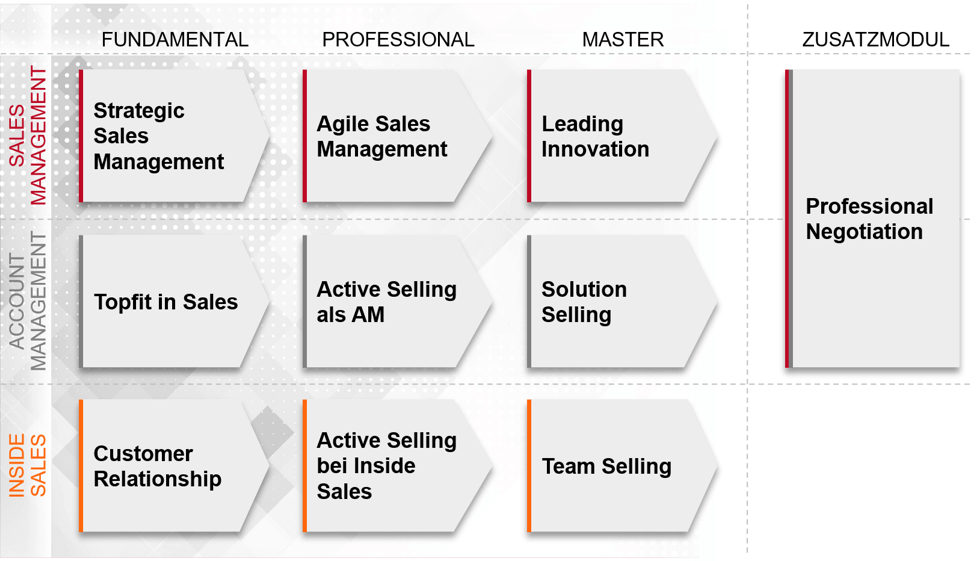
Overview of the qualification programs - The training program was created as a rough concept in a qualification workshop and then further developed and coordinated with the concept sponsors.
Training concepts adapted to cultures and markets
At the same time, the concepts for the sales organizations abroad - including in Southern and Eastern Europe, Asia and North and South America - were adapted to local cultural practices and market conditions in order to create the necessary acceptance for the global implementation of the new sales strategy.
These training measures started at the end of the year. In total, the program development and global roll-out of the training program took 1.5 years, enabling a workshop to be held towards the end of 2017 to evaluate the qualification measures with the project managers in the Group.
The overall concept of the sales qualification initiative envisaged that the three target groups would always take part in two 1.5 to 3.5-day face-to-face training sessions in small groups as part of their training (sales managers: 2 x 3.5 days; account managers: 2 x 2.5 days; inside sales employees: 2 x 1.5 days). The decision was made to start with the sales executives, i.e. the sales managers. After their first training module, they nominated the participants from their area for the qualification program for account managers and inside sales employees.
The sales managers prepared their employees for the training measure in team workshops, which they carried out themselves using a moderation concept created by us. The face-to-face modules were each prepared and followed up with online modules and web meetings, as it was important, among other things, that
- hardly any cognitive knowledge needs to be taught in the training courses,
- the participants train the new sales strategy behavior primarily on the basis of case studies from their everyday sales activities and
- participants have a contact person for implementation issues after the training.
Central focus on transfer to everyday sales work
The methods used in the face-to-face training sessions were chosen accordingly. The overall concept was geared towards largely independent learning. The trainers were always available to the participants as learning partners and implementation coaches, also to ensure the desired transfer. Corresponding transfer tasks were also agreed towards the end of each training course.
Following this basic concept, in 18 months
- almost 80 sales managers in 10 groups,
- almost 200 account managers in 20 groups and
- over 150 internal sales employees qualified in 12 groups.
In the final evaluation workshop, the Group's top sales managers noted, among other things, that with the help of the qualification programme, it had been possible to anchor the new market development and sales strategy in the organization in an "astonishingly short time" to such an extent that it was "understood and accepted throughout the Group" and "largely brought to life in day-to-day sales". This is also reflected in the Group's sales figures. However, the strategy is not yet finally "anchored in the DNA of all employees". The Group will ensure this with its managers by means of further job-related qualification measures, such as team workshops in the business units and organizational units.
WE BRING YOUR STRATEGY TO LIFE
Successfully anchoring sales strategies. Complex change processes require clear planning, consistent implementation and the involvement of everyone involved. With targeted qualification measures and practical training, it is possible not only to communicate new strategies, but also to bring them to life in everyday life. If you are considering how change management in sales can have a lasting effect, please contact us - together we will develop approaches that will secure the future.
You can find out what this can look like here: Case studies & experience reports