
Retain and develop junior (management) staff with business mentoring

Mentoring is of the same mind like..."...Imagine a world in which the whole knowledge of mankind is accessible for everybody. That is our goal!" (Jimmy Wales, Founder of Wikipedia). Mentoring embodies an instrument that focuses on the transfer of knowledge between mentor and mentee. The mentor, who is usually an experienced leader in the company, supports the mentee in their professional or personal development within the company.
Effective business mentoring is closely linked to the business context and is aimed at employees in new positions or young/new employees or managers. The mentor is usually a member of the organization with experience of the organizational context. In rare cases, a mentor can also be external to the organization and share precisely the experiences and advise on topics from which a mentee should profitably benefit for the company.
Mentoring topics
A mentor addresses topics and addresses skills that will benefit the organization in the future and prepares the mentee for challenges and problems that the mentor has already experienced and learned from, such as:
- All business challenges and project-related questions
- Leadership and management
- Current conflicts in the team or with individuals
- Career development
- Leadership and management
- Current conflicts in the team or with individuals
- Career development
- Understanding the systemic principles of the company
- Formal versus informal decision-making channels
- Hierarchical topics
- Interdependencies and social knowledge
- Formal versus informal decision-making channels
- Hierarchical topics
- Interdependencies and social knowledge
Mentoring formats
There is a wide variety of mentoring formats that support the effectiveness of the mentoring process:
- Face-to-face entertainment
- Shadowing
- The mentor "plays" the shadow and accompanies the mentee in their everyday (professional) life or on special occasions and gives feedback afterwards
- Network meeting
- Business congresses/meetings
- The mentor invites the mentee to observe a "role model" situation
- Keynote speech at a network meeting or special event
- Any interesting business situation: negotiating with contractors; meeting with clients; preparing a presentation for the management team...
- The mentor "plays" the shadow and accompanies the mentee in their everyday (professional) life or on special occasions and gives feedback afterwards
Being creative and choosing the right format that creates a suitable learning atmosphere makes both parties feel comfortable and supports the mentee in achieving their goals. Depending on the mentoring topic, the mentor's support of the protégé is designed for long-term periods.
The mentoring process

Fundamentally, mentoring requires an attitude that strives for a win-win situation. Mentoring is a self-directed learning and development process that allows the mentee to discuss any problems or development needs with an experienced mentor. A mentor is an experienced person who shares their knowledge, experience, personal networks and contacts with the mentee.
The mentor therefore supports the mentee in their professional and personal development. The mentee learns and develops through reflective thinking and benefits from the mentor's knowledge. There are no strict rules for the mentoring process - it is a (mostly) voluntary and flexible agreement between the mentor and mentee.
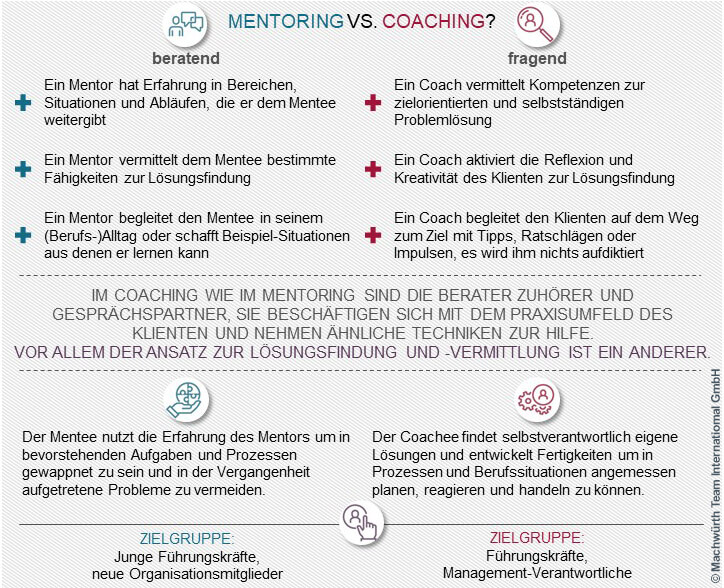
Mentoring vs. coaching?
You often read and hear that mentoring is better than coaching or vice versa. Both measures are similar and use similar techniques, but also have clear differences and pursue different objectives. The client's self-management skills must be well developed.
Author:
I am Marion Quaas-Reinhard, Senior Consultant and Leadership Coach at MTI. Among other things, I introduce business mentoring in organizations - from isolated solutions for a small group of managers to group-wide mentoring processes.
WE BRING YOUR STRATEGY TO LIFE
Developing junior staff - retaining them in the long term with business mentoring. Mentoring is much more than a transfer of knowledge: it creates a trusting learning partnership between experienced leader and mentee, promotes reflective thinking and strengthens individual skills. In contrast to coaching, mentoring is more firmly anchored in the organizational context and prepares young employees or managers specifically for future challenges. In this way, companies benefit twice - through the personal development of their talents and through the long-term benefits for the organization. If you are considering how you can use mentoring to promote and retain your junior staff, please contact us - together we will develop solutions that have an impact.
You can find out what this can look like here: Case studies & experience reports