
Conflicts in the team? 7 important steps for conflict moderation

Most people associate the word "conflict" with something unpleasant. However, conflicts sometimes also have a positive function. For example, they can drive developments forward - provided they are handled correctly.
When people work together, conflicts arise time and again, as different opinions, assessments, interests and needs clash. This is often the case in times of crisis and market upheaval, such as the current ones, when many companies have to deal with the coronavirus.
- rethink their previous (action) strategies and maxims and
- have to set new priorities - also because their financial scope for action is narrower.
Conflicts are then pre-programmed, so to speak.
But conflicts are not only negative. On the contrary! In fact, the long-term absence of conflict should be an alarm signal for managers. Because then their employees are often no longer passionate about their work. So they don't rub shoulders with each other. As a result, no change takes place. This is why managers should sometimes even stir up smouldering conflicts in order to accelerate developments.
A conflict or just a clash of interests?

What is a conflict anyway? Here is a current example:
Let's assume two employees work in the same department. Mr. Friebe comes to the office every day from morning to evening, while Ms. Hintz works from home all the time due to coronavirus. This is not a conflict as long as they both agree. Let's now assume that Mr. Friebe also wants to work from home. However, he can only do this if Ms. Hintz comes to the office instead of him. When asked about this, she says: "Not possible. I have to stay at home because of my children; besides, my elderly father is in the high-risk group for coronavirus." Even now, there is still no conflict if Mr. Friebe accepts this reason and puts his interests aside.
The clash of interests only becomes a conflict when Mr. Friebe thinks: "I should always be considerate. This egotist doesn't care what I want." Because now Mr. Friebe and Ms. Hintz are hindering each other in achieving their goals. They are also dependent on each other. When Ms. Hintz works from home, Mr. Friebe has to come to the office - and vice versa. And because Ms. Hintz refuses to come into the office sometimes, for example two days a week, Mr. Friebe feels that his interests are not being taken seriously: He is hurt.
A conflict is therefore characterized by three elements:
- mutual target obstruction,
- interdependence of the parties involved and
- Injury at the relationship level.
This is also the starting point for managers to recognize conflicts at an early stage. For example, by analyzing them:
- Who is dependent on whom and how? And:
- Which employees are therefore potential conflict partners?
Do not intervene in every conflict
Should managers intervene in every conflict?
No! Because their main task is to ensure that their employees (together) deliver the required performance. So they should only intervene in the event of conflicts that reduce performance. But how? Sometimes managers can manage conflicts by resolving the dependency between those involved. For example, by separating their areas of work so that the conflicting parties no longer hinder each other in achieving their goals. However, the ideal way to manage conflict is to remove the blockages that prevent the "opposing parties" from achieving their goals - for example, by working together in conflict moderation to find a way in which both sides can realize their interests as far as possible.
But can a leader moderate every conflict?
No! If she is emotionally involved, for example, then a neutral person should take over the moderation. It is similar if the leader expects a certain solution. Or if there are (overriding) goals or constraints that they want or need to enforce. In this case, moderation is not called for, but rather the use of classic management instruments such as instructions or performance agreements.
Clarify problem awareness, obtain consent
Suppose you are now considering conflict moderation as a leader . Then you should clarify the problem awareness in advance. Because sometimes employees react with surprise when they are approached about conflicts: "What makes you think that?" They negate the conflict. You should therefore first clarify whether the people involved are aware of the conflict and whether their level of suffering is so great that they are prepared to invest in resolving it.
You should then obtain the employees' consent for conflict moderation. For example, ask them to describe the course of the conflict - but refrain from evaluating it. Instead, ask about the effects and whether the situation is satisfactory for the parties involved. If they answer "of course not", the parties to the conflict are probably ready to take a new path. You can then suggest conflict mediation.
However, leave it up to the parties involved in the conflict to find their own moderator. Only offer to act as a moderator if the employees explicitly request this. And explain to them why you are willing to moderate the conflict - for example, because you want the two "opponents" to work in a more positive atmosphere again and therefore more effectively.
In the event that the parties to the conflict choose you as the moderator. Then you should give them a precise description of the moderation process. Also ask them to think in advance about what behaviors they would like to see from each other in order to work better - but not changes in character, only changes in behavior.
Conflict moderation: take a structured approach and follow the rules
The following is an example of a possible conflict moderation process for a conflict between two employees.
1. boarding
Employees usually come to conflict moderation full of emotions. As a moderator, you should therefore say a few words about the topic of conflict to start with. For example, conflicts exist everywhere - not just in the company. Conflicts also arise again and again. For example, because requirements change. So new solutions to problems have to be found again and again. This is why conflicts are often an important impetus for innovation.
Explain to the "brawlers" once again what conflict moderation is all about: resolving the conflict. However, not in such a way that all the emotions and experiences of the past are dealt with, nor by covering up the conflict with formal regulations - as is often the case in companies. Rather, the working relationship should be renegotiated and the behavior at the interfaces of the two employees' fields of activity should be regulated in such a way that both can live with it and do their job better. No more and no less.
2. define rules
Define rules for moderation with the conflict partners. For example:
- Both make demands on the behavior of the other.
- These are negotiated according to the principle of "give and take".
- The agreements are set out in writing.
Also agree with the conflict partners what will remain in the room and what may be discussed with third parties. Also clarify your tasks as a moderator with them. For example:
- I behave neutrally and ensure that the rules are observed.
- Intervene if the other person is assumed to have "bad" intentions.
- I prevent negotiations from taking place about undiscussable issues, such as the company's goals.
- Ensure that no agreements are made to the detriment of third parties.
3. collect topics/demands
Once the formalities have been clarified, you can ask the parties involved to complete the following statements on a form, for example:
- It would help me work more effectively if you did the following more/differently: ....
- It would help me to work more effectively if you would do the following less/no more: ....
- Please keep up the following activities to help me work effectively: ....
4. clarify understanding
You should either copy the completed forms or hang them up so that everyone can read them. Ask the conflict partners to formulate each other's demands/wishes out loud in their own words. "You want me to ..." - The other person should either confirm or correct the statement. As moderator, ask for examples of the desired behavior, if necessary, to ensure understanding.
5. prioritize and negotiate demands
Both parties to the conflict can then use a symbol to mark the demands that are particularly important to them and another symbol to mark the demands that are negotiable. They should then make each other offers. For example: "If you inform me promptly, I would accept....". As the moderator, make sure that the negotiation is a real give and take.
6. agreements and protocol
Make a note of all agreements. It is normal for emotions to boil over during this negotiation of the future working relationship and for "experiences" from the past to be recounted. You should allow this to happen so that the pressure is released. However, you need to show tact to prevent the other person from building up pressure. After the emotional outburst, calmly analyze that it shows how much emotion is involved and that such injuries certainly exist on both sides. And then suggest: "Let's get back to the kind of behavior you want."
7. finalize and arrange a follow-up appointment
The agreements reached during conflict mediation often appear to outsiders to be trivial or self-evident. However, they are important for those involved because emotions are attached to them. These points should therefore be organized in a sustainable manner so that old wounds are not reopened at a later date. It should also be agreed what happens if agreements are not kept. These do not have to be sanctions. The agreement can also read: "Then we'll talk about it in future - instead of swallowing the anger." However, you should always arrange a follow-up appointment to check whether the agreements have been kept and whether any new points of conflict have arisen that need to be addressed.
Arm yourself for an increasing number of conflicts
If you proceed according to the methodology described above, you as a leader can certainly resolve many an interpersonal conflict that arises in your area during the time in which we are still living or have to learn to live with Corona. Because you should never forget one thing: Due to the many changes and uncertainties that Corona brings with it, it is not only the nerves of many managers that are on edge. The same applies to their employees. Not only do their emotions quickly boil over, but conflicts also arise between them.
Please contact us for detailed advice on conflict management and an individual concept tailored to your needs.
This article was written by Sabine Machwürth, Managing Director of MTI-Shared Services and has been published in a modified form in "BildungAktuell - Das eMagazin für Management, Personalwesen und Weiterbildung". You can find the article here.
More about conflicts and team management

Digital learning in small and medium-sized enterprises
Today on the MTI KnowHow Podcast is our expert, Marie Meiners from Team Connex. She [...]
MTI KnowHow Coffee - 20 questions for Jasmine Albrecht
"20 questions for Jasmine Albrecht" - Our last cup of know-how of the year! We [...]
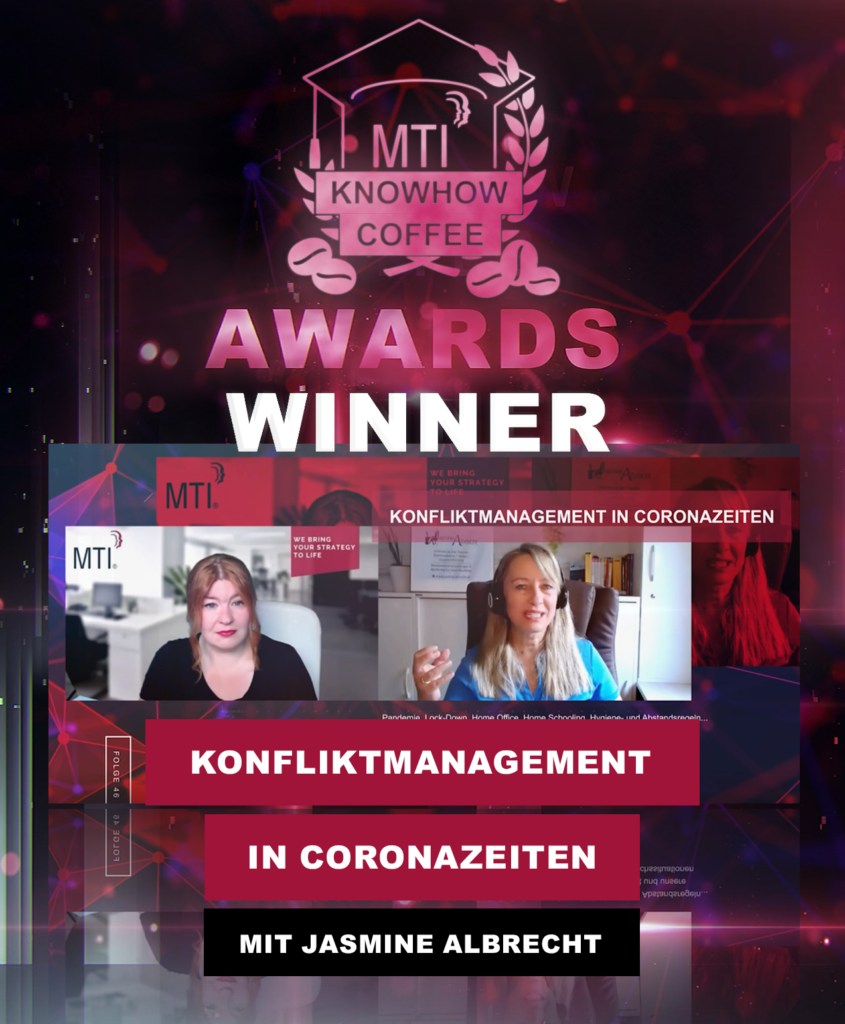
MTI KnowHow Coffee AWARDS - The winner has been announced!
TROMMELWIRBEL!!!! The Award goes to ?!?....Jasmine Albrecht!! Many thanks to all those who [...]

The lost first episode of MTI KnowHow Coffee: LEGO® Serious Play®
Cold coffee? Not really a highlight for anyone - in this case the [...]

What do the microwave, Walt Disney and Santa Claus have in common?
Today it's not just about filled boots... For all those who want to [...]

Natural laws of leadership
Our impulses to act are controlled by three parts of the brain - the reptilian brain (essential for survival [...])
Assertiveness: strong woman or bitch?
Strong woman or bitch? ? What associations are awakened in us when we [...]?
Empathy + leadership - a contradiction ?!?
Managers cannot be empathetic. Employees need to know where they stand and [...]
The Subtleties of Trust
Trust is very important in teams, organizations and 1:1 relationships. When companies realize their vision [...]
That's it for our collaboration - Resolving conflicts with mediation
Solving conflicts constructively with mediation: In today's working world, where more and more [...]
WE BRING YOUR STRATEGY TO LIFE
Conflicts in the team - an opportunity instead of a risk. Differing opinions and interests are part of everyday working life and, if properly moderated, can even drive developments forward. The following applies to managers: intervention is only necessary when conflicts impair performance. The ideal approach is clear moderation - with an awareness of the problem, the consent of those involved and a focus on concrete changes in behavior rather than questions of character. Addressing conflicts at an early stage and providing constructive support not only strengthens the team climate, but also the performance of the organization. If you are considering how you can effectively anchor conflict management in your company, please contact us - together we will develop solutions that have a lasting effect.
You can find out what this can look like here: Case studies & experience reports