
From charge to serenity

Achieve serenity and relaxation through Introvision
Excessive external complexity in our working world can cause uncertainty among individuals and spread to the entire team. The internal operating temperature rises. Seemingly out of nowhere, we no longer feel able to act as usual. This can be recognized by tunnel vision, spinning thoughts and physical tension. The normal and understandable reaction is to exert even more effort or avoid the unpleasant situation, for example a conflict. In doing so, we enter a state of inner charge. With the scientific Introvision method, it is possible to regain composure in such situations.
We talk to our MTI consultants Melanie Them and Uwe Riebling about how Introvision works, the positive effects it has on teams and how Introvision can be used in companies.
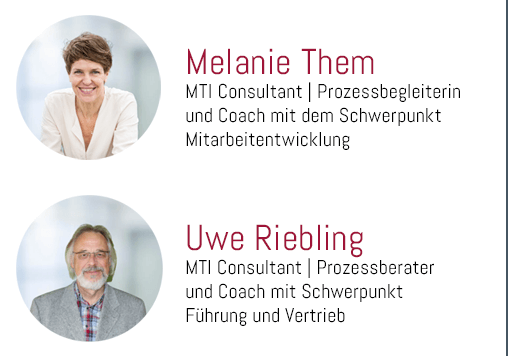
Both are trained Introvision consultants from the Intervision research group at the University of Hamburg (method developed by Prof. Dr. Angelika C. Wagner) https://www.introvision.de Introvision research group at the University of Hamburg https://www.introvision.uni-hamburg.de
What does serenity mean from a scientific perspective?
Melanie: Serenity in general describes a state of inner calm combined with a feeling of effortlessness. When we are absorbed in our work, lose our sense of space and time and are open to our environment. In the midst of the greatest hustle and bustle, we remain calm, feel able to act and react in a balanced way.
Prof. Dr. Wagner* defines serenity as follows: When we refrain from doing something in situations where we are "on edge". For example, when a project deadline is approaching that can no longer be met, we tend to put ourselves under pressure and act on impulse. We do everything we can to achieve this goal after all.
The following graphic (scale) describes very well what is happening to us at this moment:
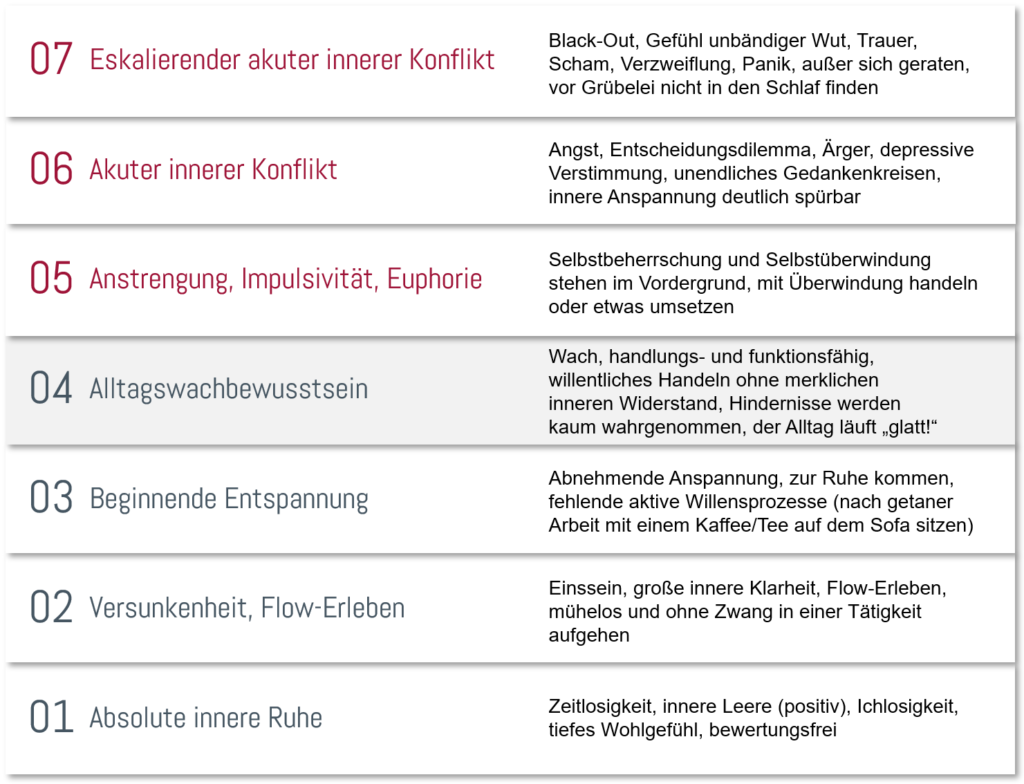
Uwe: This scale was developed by Prof. Dr. C. Wagner. She differentiates between seven inner states. The basis for this was provided by extensive literature research in the field of cognitive psychology. It illustrates the different stages very simply and makes it easy for people who want to get to grips with the subject to connect with it.
Inner states and what they mean
Uwe: This scale goes from level one "absolute inner calm" to level seven "escalating acute conflict". If we are relatively relaxed and without any noticeable inner resistance - a kind of "normal zero" - then we are at level four, the "everyday waking consciousness". In this state, we are awake, able to act and can think, even if it is difficult at one point or another. We act without any noticeable inner resistance. It is beneficial for people and teams to strive for this state.
In levels 4 to 1, we are talking about the area of serenity. We are relaxed, everything is effortless and we are absorbed in our work. From level 5 upwards, we look at the area of "decreasing composure" and "non-composure". The core characteristic of level 5, for example, is acting against inner resistance. When I escalate from these levels of serenity and get into this "not serenity", Introvision helps me to reflect and get back to a state of serenity (from level 4-1).
(For more details, see the corresponding Knowhow Coffee episode)
How can I regain my composure?
Melanie: Introvision is a method for mental self-regulation. Research has been carried out into how you can regulate yourself from level 5 or 6 back down to "everyday suitability" within a few seconds. And Prof. Dr. C. Wagner has developed the core of this method - CONSTATUTING AWARENESS (KAW for short). This is a scientific perception training course that focuses on observing and evaluating/getting to know the qualities. And above all to practise non-judgemental observation and description. We are used to evaluating throughout the day, e.g. when we make decisions. We are less used to "just" observing (non-judgmental, unbiased). It is about controlling the inner focus of attention in a targeted way and bringing about calmness when we have to make decisions under pressure or great uncertainty. This resulting inner restlessness, this conflict, can be regulated by the KAW method, which enables us to make good decisions under pressure.
A few examples: If we are approached brashly and unexpectedly in a meeting, I can use KAW to regulate my ability to act/sovereignty and react accordingly (or not react - stay calm) and accept it for what it is. Or I have to give critical feedback to an employee and I am caught between "I have to give this critical feedback" and "but I also have to be liked, I have to be friendly". This is where KAW comes in, to quickly maintain our ability to act/our sovereignty. This works with individuals as well as in teams. Most of the time we act on impulse and afterwards we think "if you had reacted differently". With these KAW awareness exercises, you basically learn to control this impulse, to regulate yourself
How can I learn KAW?
Practical exercise - non-judgmental perception | observing instead of evaluating
A very practical exercise on how we learn to distinguish between observing and evaluating. Take a moment and look at your desk. What do you see? Colors, shapes, shades. Or there's a to-do list in front of you; observe what's on it: create a concept, write an email, make phone calls. If I start to think "oh dear, I won't be able to do any of that today", then I get into the judgmental mindset that causes me to become tense. With this simple exercise, I can determine or get to know my own quality between observing and perceiving.
My personal favorite KAW is when I go for a walk or open the window and listen to everyday life. What does it sound like, what different noises do I hear (traffic noise, birds, people talking...) Take the judgment out of it completely and just listen.... These are ways of actively practicing this.
EMOTIONS ARE CONTROLLING Emotional states can also be transferred to another person. This is human and completely normal. It is about dealing with these unplanned situations and realizing that it is completely normal to react with old mechanisms (impulses). These are wired in the brain much faster than the conscious mind. Experience has shown that the sensitization that results from perception training enables us to recognize much more quickly that something is building up inside. If something happens and I can't control myself, it helps to pause for a moment and not follow the first impulse. Emotions are contagious and experience has shown that calmness is too. This can also be very helpful for teams! As calmness is just as contagious, the relaxed behavior of an individual can change the attitude of the entire team.
Melanie: When I go into a team meeting with a non-judgemental attitude, I manage to positively influence a room with my non-judgemental, open attitude. With my attitude, I create a space in which better work is possible. The KAW not only helps you to regulate yourself, it is also THE attitude for coaching and training. When we support teams in developing new services/products using agile methods - e.g. design thinking - we create a space in which precisely this is possible. To develop freely, to think in new ways and to let thoughts flow.
How do I manage to stay in balance?
Uwe: That's the sensitivity I was talking about earlier. The refinement of what I notice, what I perceive. And when I realize at this point that I'm going back to thinking and start to tense up again (oh dear, I still have to do that and I mustn't forget it....) then say to myself: "Stop, I had planned to just perceive in these three minutes", collect myself once again and start to register pure perception again. That is the process you learn, so a second learning point is to notice when you are evaluating and when you are perceiving.
"Daily self-control is priceless."
Uwe: The first step is the desire to engage with it, to refine your perception and to become more variable in your focus - that means training and practice.
With regard to team performance, we have developed an approach in which we explore the topic of composure (not yet perception) - how we feel in contact with each other, what concerns us, what upsets us. We reflect on this topic together with the team on the basis of our daily work.
If you would like to find out more or have any questions for our experts, please send us an email to: info@mwteam.com
You can find the detailed conversation about inner serenity in our Knowhow Coffee episode: Knowhow Coffee episode
WE BRING YOUR STRATEGY TO LIFE
Calmness works - for individuals and for teams. We help you to train your perception and attitude in a targeted manner in order to maintain inner calm in complex situations and thus have a positive influence on the entire team. If you are considering how to use calmness as a resource in your organization, please contact us - together we will develop approaches that have an impact.
You can find out what this can look like here: Case studies & experience reports