
Inclusion in the workplace: finding skilled workers, embracing diversity, reaping the benefits

Many companies today are faced with the challenge of finding new ways to recruit qualified specialists. People with disabilities are often overlooked, even though they bring valuable skills and potential to the table. Inclusion is therefore not just a "nice-to-have", but a decisive competitive advantage and strategic success factor for companies. In this article, our consultant Christina Bolte explains what inclusion actually is and highlights five reasons why the targeted promotion of inclusion in companies is worthwhile. At the same time, we want to clear up some misinformation that falsely portrays this process as difficult. Inclusion means that all people - regardless of physical, mental or psychological impairments - can participate in social life on an equal footing. In the working environment, this means designing working conditions and processes in such a way that people with disabilities can make the best possible use of their abilities and perform their work to the best of their ability.
Although most people think of wheelchair users when they see the disability pictogram, mobility restrictions only account for a small proportion of all disabilities. It is therefore not just a matter of removing physical and digital barriers, but also of creating a working culture in which diversity is seen as an enrichment and actively encouraged. This can be achieved through barrier-free premises, suitable technical aids or flexible working hours. The focus is on adapting workplaces and the operational framework in such a way that individual strengths are promoted and any impairments are compensated for in the best possible way.
This chart provides a good overview of the current situation on the labor market:
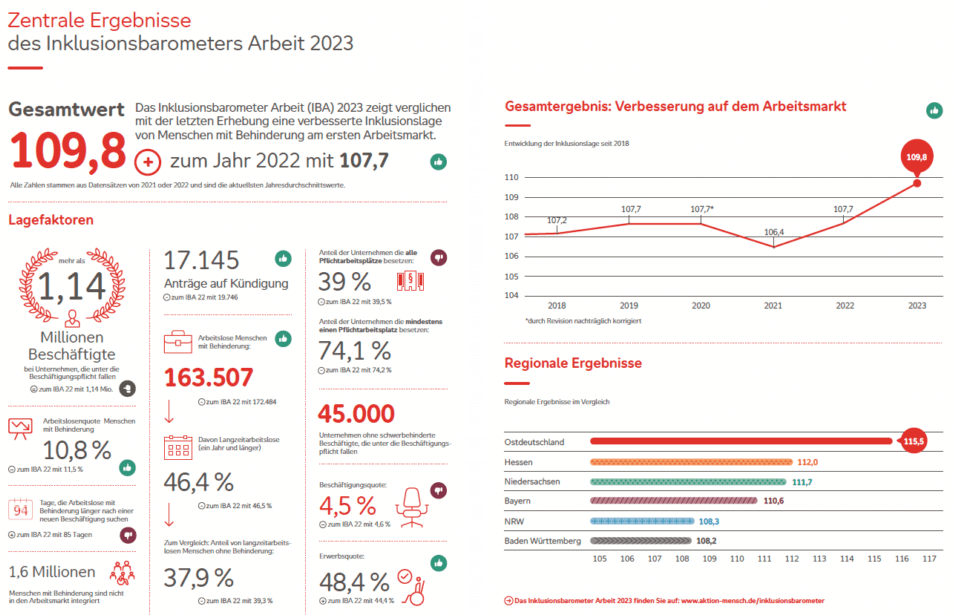
Inclusion Barometer 2023 | Aktion Mensch + Handelsblatt Research Institute
So why is it worth looking into inclusion?
Inclusive workplaces therefore offer equal opportunities for everyone and at the same time increase the performance of the entire company.
1. access to a broader base of skilled workers
The shortage of skilled workers is one of the biggest challenges in many industries. Companies are desperately looking for qualifiedemployees in order to remain competitive. People with disabilities are a group that is often not given sufficient consideration, even though they have valuable qualifications and skills. According to a study by Aktion Mensch, people with disabilities are just as well educated as their non-disabled colleagues, and many have completed vocational training or a degree.
By actively integrating people with disabilities, companies open up access to a larger number of potential skilled workers. This not only expands the talent pool, but also makes it possible to attract highly qualified employees who can ensure innovation and company growth.
2. increase in innovative strength
It has been proven that diversity, i.e. the variety of different perspectives and experiences, promotes creativity and innovation. Teams that work in an open and appreciative environment are also more productive and achieve better results.
People with disabilities have often learned to develop creative solutions to challenges in their everyday lives. They usually bring these problem-solving skills to bear in the corporate context as well. Inclusion therefore not only promotes social justice, but also contributes significantly to a company's competitiveness and ability to innovate.
Companies that focus on inclusion design their workplace conditions and processes in such a way that there are no (or few) barriers from the outset or that existing barriers are overcome. When managers and teams deal with a colleague's limitations with openness, creativity and out-of-the-box thinking, they can help them break down barriers and solve problems in new ways. This creates a diverse working environment in which fresh ideas and innovative approaches are encouraged. And a collegial atmosphere within the team anyway.
3. economic benefits and state support
In addition to the social and cultural benefits, the inclusion of people with disabilities also offers tangible economic advantages. The state supports companies that are committed to employing people with disabilities in a variety of ways. This ranges from financial subsidies for setting up barrier-free workplaces to special support programs and tax relief. In addition, state advice centers can be utilized.
Furthermore, by employing people with disabilities, companies reduce their tax burden, as they can reduce or completely avoid the so-called equalization levy. This is payable if a company with more than 20 employees does not employ the legally required number of people with disabilities (generally 5%). The integration of these employees into the company therefore also leads to direct financial benefits.
4. reduction of misinformation and prejudices
Unfortunately, there is persistent misinformation that prevents companies from hiring people with disabilities. A widespread misconception, for example, is that people with disabilities "cannot be dismissed". This misunderstanding arises from a misinterpretation of the statutory protection against dismissal.
The fact is that people with severe disabilities are subject to special protection against dismissal, but this is not absolute. These employment relationships can also be terminated for operational or personal reasons, but in these cases additional steps, such as the involvement of the integration office, must be observed. The aim of this protection is to prevent disadvantages and discrimination, but it in no way prevents companies from making decisions that are necessary for the company.
Another preconception is that people with disabilities are more often ill or less productive. Studies disprove this: People with disabilities are not sick more often than their colleagues without disabilities. In addition, companies can create an environment in which people with disabilities can develop their full potential by providing appropriate workplace equipment or flexible working hours. The reality is that well-integrated employees with disabilities are often extremely loyal and motivated.
5. strengthening the employer brand and corporate image
Companies that stand up for inclusion send a strong signal both internally and externally. They show that they focus on people and take responsibility for social values such as equality and diversity. This not only has a positive effect on external perception, but also on the internal corporate culture.
An inclusive corporate culture increases the well-being and motivation of all employees, which leads to greater loyalty to the company and lower fluctuation rates. Potential applicants see an inclusive company as an attractive employer where people are seen with their skills and potential (rather than their deficits) and are given opportunities to develop. This increases the chances of attracting qualified specialists who are explicitly looking for a company that takes diversity and inclusion seriously.
In addition, such companies also raise awareness of how other groups of people also benefit from the removal of barriers and needs, and who knows, maybe even one or two other target groups will open up.
Conclusion Inclusion as a strategic success factor - act now!
Companies that make an active effort to include people with disabilities benefit in many ways. Through the targeted inclusion of people with disabilities, you can expand your talent pool, increase your innovative strength and strengthen your employer brand. Now is the ideal time to take action and make your company fit for the future. Take advantage of the benefits of inclusive workplace design and create a corporate culture that promotes diversity and ensures long-term success. If you have any questions about implementation or would like individual advice, please contact us - we will be happy to support you on your way to becoming an inclusive company!
Author:
Christina Bolte | Senior Consultant MTI | Expert in burnout and stress prevention | Disability Manager
WE BRING YOUR STRATEGY TO LIFE
Inclusion in the workplace is more than just a trend - it opens up new potential, strengthens teams and makes companies fit for the future. We support you in actively shaping diversity, breaking down barriers and developing workplaces in such a way that everyone can contribute their strengths. If you are considering how to strategically implement inclusion, please contact us - together we can create a culture that seizes opportunities and makes an impact.
You can find out what this can look like here: Case studies & experience reports