
Hybrid working environments - the new normal for companies and their managers

A normal working day...
This morning, the first online appointment took place at 7:00 am. Just a quick tune-up. Then breakfast and a quick walk with the dog. Then it's off to the home office and the official working day can begin - 8:15 online meeting (daily with the project team), followed by four more online meetings every hour from 8:30 to 12:30, exchanges with other managers and two important customer appointments. During the lunch break, I quickly finish cooking the prepared meal and wait for the child to come home from school. Use the time for a quick lunch together and a few instructions for the family before the afternoon round begins.... Does this sound familiar to you?
Welcome to the new normal
We all know by now that the coronavirus pandemic is causing a rapid upheaval in the world of work: a short-term state of emergency is increasingly becoming the new normal. The hybrid working world is now part of our everyday lives, albeit in different forms. While some team members work virtually and others are based in the company, managers are faced with new challenges: How can good leadership work when everyone is on site at different times, some may only appear infrequently and remote working becomes a self-service store? What happens if the individual team members only meet in person irregularly or not at all?
The task of the leader in the "hybrid world" is in particular to shape relationships and to maintain and further intensify the solidarity of all team members. How does a leader succeed in reaching agreements that meet the needs of individuals and the team and still enable goal-oriented teamwork?
Did you know that satisfaction among mobile workers has risen by 0.7 points to 8.1 on a scale of 1-10 compared to traditional office workers (Forbes 2016)? A development that you should not ignore under the current labor market conditions!
Why is this topic important right now?
- The first "interim solutions" that worked in the short term are now becoming the norm, albeit often without questioning their quality and effectiveness.
- Leadership in a hybrid environment requires a new/expanded understanding of leadership.
- New areas of tension arise between the various players and must be overcome.
- Consciously exploiting the benefits of remote working are important factors for workplace and employer attractiveness.
What does this mean for managers?
All of the factors mentioned require a deep reflection and review of the previous understanding of leadership and one's own attitude. The transformation process from the traditional to the hybrid working world is not a product of chance, but requires a targeted and conscious approach, because:
- Contemporary leadership means coordinating the changed framework conditions and designing the necessary processes in communication and networking within and with the team.
- developing and designing new formats together with the team in order to jointly adjust agreements, exchange information on a regular basis and review and adapt work results or processes to ensure they are up to date.
What are the main challenges to be overcome?
- Creating connections between colleagues working on-site/analog and employees working off-site/digitally
- Get out of your comfort zone and question "old", previously important and useful habits
- Questioning yourself and repositioning yourself as a leader in the hybrid world
- See the change scenario that Corona has brought us as an opportunity and utilize the potential that has arisen
Hand on heart - did you know that 35% of employees would actually change jobs for more flexibility and working from home (Bitkom 2019)? An aspect that clearly puts managers and companies on the offensive!
What potential can companies draw from this?
- Cost savings (e.g. less set-up time, expenses for travel and commuting, reduction of office space and its infrastructure)
- Increased sustainability (e.g. lower CO2 emissions due to reduced commuter traffic and more effective use of space)
- Employer attractiveness through more flexible working hours
- Increasing employee satisfaction and motivation as well as increasing self-efficacy and influencing life-work balance
- Increased productivity due to the improved compatibility of work and personal needs
What are ways and possibilities for shaping / ways for practice?
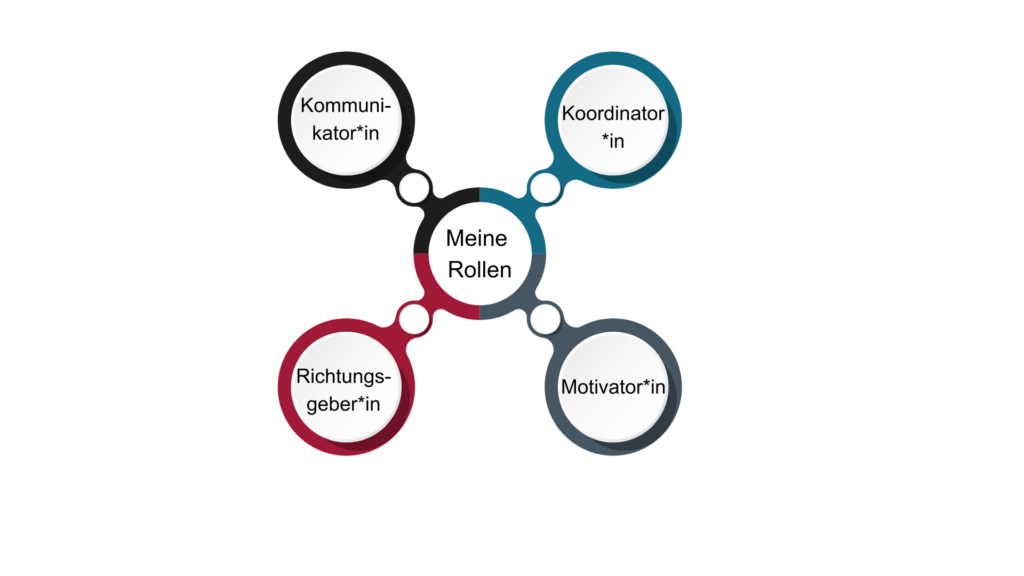
In order to derive clear options for action in practice, it is worth delving into the roles of the virtual leader . From each individual perspective, a targeted roadmap can be developed together with the team to enable more effective collaboration in the hybrid working world. As a leader, you create the platform for joint design - leave nothing to chance here.
It is therefore worth reflecting on each role individually and deriving the necessary steps for practice. One example of this is the role as a guide. From this perspective, it is essential to agree goals with employees based on the changed framework conditions, to present the overall context and thus the benefits and purpose of the tasks even more clearly and to focus clearly. How can this work? For example, as a guiding light, you can ensure that rules are agreed that help to organize cooperation well across locations and channel information flows. Take your team on board when drawing up this agreement and ensure that the agreements made are regularly reviewed and adapted to ensure they are up to date and implemented. Take the lead in your role as a direction setter and, of course, in all other roles as a virtual leader!
A guest article by Gabriele Berneiser and Ute Leopold
Gabriele Berneiser:
Gabriele brings more than 15 years of experience as a leader and over 10 years of experience as a trainer to our team - her main focus is on leadership development, leadership development, team development, organizational development, potential analyses, assessment and development centers, and personal coaching.
Ute Leopold:
Ute is also a long-standing and experienced consultant and trainer with a focus on systemic organizational development and change management. Her areas of expertise include corporate health management, leadership development and team development - from conception and design to implementation and management.
WE BRING YOUR STRATEGY TO LIFE
Consciously shaping hybrid working environments. We support managers in creating clarity and structure in virtual roles and effectively organizing collaboration across locations. This creates a working model that combines flexibility with orientation and strengthens teams in the long term. If you are considering how hybrid leadership can be successfully implemented in your company, please contact us - together we will develop approaches that will have an impact.
You can find out what this can look like here: Case studies & experience reports