
Working from Home: Between Relief and Overload—A Holistic Perspective
Rising gas prices and longer commutes are making working from home significantly more appealing again for many employees. At the same time, it is clear that working from home is no longer a marginal issue. According to the ifo Institute, 24.5% of employees in Germany worked at least part-time from home in February 2026.
Less time in the car, more flexibility, more time for yourself—at first glance, that sounds like a healthy work-life balance and a clear win-win situation.
But this is precisely where an often underestimated challenge lies:
Working from home does not automatically mean working in a healthy way.
It often happens to me that I start my morning right away with my first appointment and don’t realize until hours later that I haven’t taken a proper break yet. I’m sure you’ve experienced this too. It’s exactly these little patterns that show how quickly healthy routines can fall by the wayside in our daily work lives.
Greater flexibility often goes hand in hand with less structure. The day quickly fills up with meetings, periods of focused work drag on longer than planned—and breaks are often skipped without us even realizing it.
What used to be the commute to work is now missing as a deliberate transition between work and personal life. Instead, the day often begins right in front of the screen—and ends there as well.
At the same time, new habits form very quickly:
- less physical activity in daily life
- longer periods of sitting
- last-minute emails sent in the evening
This often happens gradually, too: you stay seated for just a moment, quickly reply to a message, and only realize later just how exhausting the day actually was.
What often goes unnoticed is that our own stress levels rise gradually. Without clear external cues, it becomes harder to take breaks or switch off in time.
Working from home isn’t a sure thing—it requires careful planning.
And this is exactly what determines whether it will provide relief or become an additional burden in the long run.
Risks of Working from Home
What many people lack: clear boundaries.
The lines between work and personal life are blurring, people are taking fewer intentional breaks, physical activity is on the decline—and social interaction often falls by the wayside.
What’s more, without an external structure, many people find it difficult to actively manage their own workday. Meetings pile up one after another, periods of concentration run longer than planned—and the chance to take a breather keeps getting put off.
Maybe you've been there: You just wanted to stretch your legs or grab a coffee after your last meeting—but instead, you find yourself diving right into the next task. Especially when working from home, these small breaks—which are actually important—can easily slip through the cracks.
Studies show:
- Many employees are significantly less active when working from home: According to a study by Techniker Krankenkasse , 56% of employees say they are less active when working from home than when in the office - (Source: TK-Die Techniker)
- Stress and exhaustion are on the rise: 75% of remote workers report experiencing stress or burnout, while more than a third are actually working more than before (Source: Wrike)
What is particularly concerning is that these developments often creep up on us. They do not happen overnight, but develop over time—and often go unnoticed. Without clear external signals, signs of burnout or a lack of rest are not recognized until it is too late.
So staying healthy while working from home doesn’t just happen on its own—it requires active effort.
The Key: The 5 Levels of Health
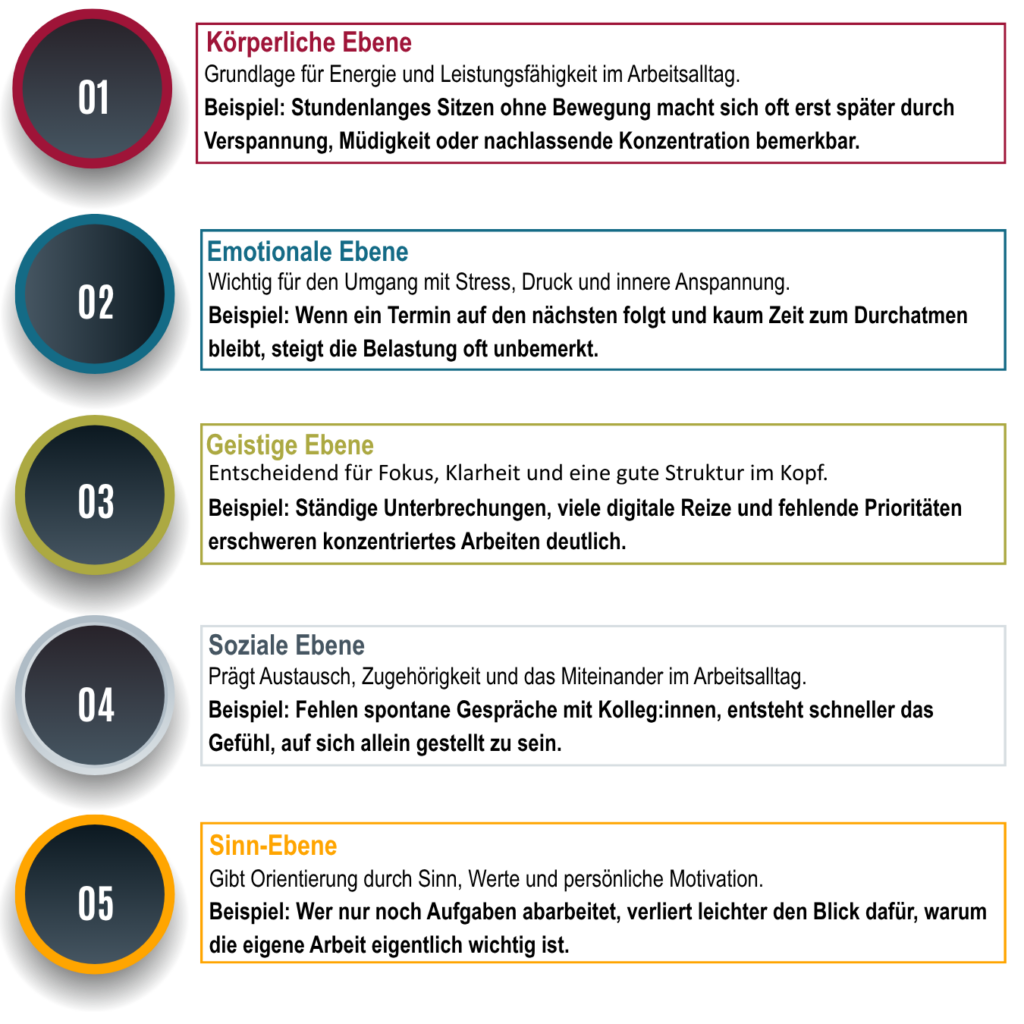
A helpful approach is the concept of the 5 levels of health.
This concept is based on a holistic understanding of well-being: health arises not only on a physical level, but also through the interplay of emotional, mental, social, and purpose-oriented aspects.
This holistic approach is particularly relevant when working from home: While certain aspects (such as work or screen time) tend to take center stage, other areas—such as physical activity, social interaction, or intentional rest—often take a back seat.
The result: Imbalances do not arise suddenly, but develop gradually—often without being immediately noticed. This is precisely where the model comes in: It helps us understand health not as a single measure, but as a conscious interplay of various factors in everyday life.
Do’s and Don’ts for Working from Home
Especially when working from home, it’s worth taking a close look at your own habits. After all, it’s often not the big changes but the small daily habits that determine whether your work remains healthy and well-organized in the long run.
Do's - Setting a positive example
Don'ts - Common Pitfalls
Take breaks and communicate
Expecting to be available at all times / allowing it yourself
Process emails at set times
Schedule meetings back-to-back without breaks
Make exercise breaks visible
Sending emails late at night
Consciously set and maintain boundaries between work and leisure
Turn a blind eye to overtime
Discuss healthy habits as a team & share ideas about them
Ignoring your own exhaustion or signs of exhaustion
Small steps, big impact
Lasting change doesn't come from grand resolutions—but from small, concrete habits.
A simple approach from the training:
If-then plans
Example:
- “When I start my workday, I make sure to schedule my first break right away.”
- “When a meeting ends, I get up for a moment and move around for two minutes.”
- “When I schedule a meeting, I set it for 45 or 55 minutes instead of 60, if possible.”
- “Whenever I go to get a cup of coffee or a glass of water, I make a point of stretching.”
- “When I take my lunch break, I step away from my desk for a few minutes.”
- “When I notice that my concentration is waning, I take a short break from the screen.”
This is how new routines develop almost automatically—they require little effort but often have a big impact on your daily work life while working from home.
Self-assessment: Where do you stand right now?
Take a moment to reflect honestly:
- On a scale of 1 to 10, how healthy is my current work-from-home routine?
- Which level is already working well?
- Where do I need the most improvement?
- What small change could I make right away?
Working from home offers tremendous opportunities—but only if we learn to approach it thoughtfully.
Healthy work doesn’t start in the office. It starts with us.
WE BRING YOUR STRATEGY TO LIFE
The question of how you deal with young talent, knowledge and skills today will determine the future of your company. For many years, we have been helping organizations to build bridges between generations and develop talent in a targeted manner. If you are considering how you can future-proof your talent management, please contact us - together we will develop a sustainable strategy.
You can find out what this can look like here: Case studies & experience reports