
leader and emotional manager at the same time

Managers must be able to control their emotional balance and their behavior. Not only to avoid personal burnout, but also so that their behavior remains predictable for their employees and they perceive it as fair.
Companies are social systems. This means that many people work in them and for them. And they are connected to each other through numerous communication and working relationships. This is why emotions also play an important role in everyday working life. They influence the working atmosphere and work motivation and therefore also the effectiveness of cooperation. This has been proven by numerous studies.
But is it even allowed to show emotions in everyday working life - especially as a leader? Or do companies expect their key personnel such as managers and project managers not only to have a thick skin and seemingly limitless resilience, but also to always radiate good humor and confidence?
There is no doubt that it is important that a largely "good atmosphere" prevails in a company in day-to-day dealings with one another, among other things because interaction is characterized by mutual appreciation and mutual respect. Only then will employees identify with their work and their employer in the long term, be motivated and also present a good image to the outside world - for example in contact with customers.
But what does a "good mood" or working atmosphere depend on? Of course, it also depends on external conditions such as whether a company is doing well economically or whether it is under massive pressure to change. However, the behavior of managers is far more decisive. After all, their decisions and behavior largely shape the day-to-day work of their employees. This is why managers should be able to control their emotional balance - and do so in such a way that they still come across as authentic to their counterparts. A mask-like smile, for example, is quickly seen through by the other person as fake because it is put on, and it often creates mistrust and therefore distance. It therefore often has the opposite of the intended effect.
Managers have emotions too
A key prerequisite for managing your own emotional balance is that managers first accept this: We are also emotional beings (made of flesh and blood) with desires and needs, fears and anxieties, preferences and things that we dislike.
That sounds obvious! But it is not. Quite a few managers have internalized the self-image. I act and decide (purely) rationally. They are also convinced that as a leader you have to grit your teeth and not show your feelings. For example, when you have to deliver negative news to employees due to your exposed position in the organization. Quite a few managers then become a kind of apparatchik, announcing the facts but showing no emotion whatsoever - out of fear, for example,
- then I come across as weak and not very strong in implementation or
- then I get involved in endless discussions.
As a result, employees no longer perceive their leader as a person with heart and a person with empathy. This puts a strain on their relationship with the leader and this in turn affects their motivation to work. Because countless studies prove it: Employees are more committed to their work the more they can identify with their immediate superiors (and colleagues). If the relationship with them is right, they feel good about the company. So they are also committed to the company.
Goal: To be fair and predictable
One prerequisite for this is that they experience their manager not just as a "machine" that fulfills its function, but also as a person who listens to them, understands them and, like them, sometimes has good days and sometimes rather bad days. Managers should therefore show emotion in their day-to-day dealings with their employees. And they should use them in a targeted manner to achieve their goals.
To do this, managers first need to know their emotional reactions. But this alone is not enough. Managers should also know which factors trigger the respective reactions in them. They should know, for example:
- Now I'm reacting irritably because I'm stressed. Or:
- Now I'm avoiding it because I'm afraid of conflict. Or:
- Now I'm reacting angrily because I've just been annoyed with a supplier myself. Because otherwise they are quick to behave unfairly towards employees.
Showing emotions does not mean lashing out wildly, but rather showing them in a controlled manner. A leader can express their frustration as long as they know that this will not infect the employees. Expressing negative feelings can even be a way of making personal contact with employees and gaining their understanding, especially in difficult times. For example, when a leader articulates their own insecurity about the fact that unforeseen events such as the coronavirus pandemic, the war in Ukraine, etc. have been constantly throwing all plans out of kilter for several years now.
Managers should therefore learn and accept that their behavior is also subject to emotional fluctuations. This also means that while they sometimes react rather calmly to certain employee behaviors, in other situations they may become enraged - for example, because they are stressed or have not slept well.
Ensuring a balanced emotional equilibrium
To a certain extent, such emotional fluctuations are acceptable for your employees - especially if they know what is causing them. After all, they want to experience their boss as a person. Emotional fluctuations or outbursts only become a problem for employees when their boss's behavior becomes unpredictable for them. Because then they often experience this as unfair or inappropriate. So they distance themselves emotionally from their boss - partly because they no longer know how to behave in order to avoid his or her attacks of anger or biting criticism, for example.
Managers should therefore ensure that their emotional balance is largely in equilibrium. To do this, they must be aware that their behavior at work is also influenced by how satisfied they are with their lives in other respects.
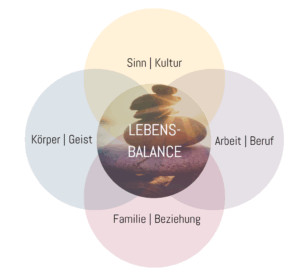
According to Nossrath Peseschkian's life balance model, four areas can be distinguished in our lives. In addition to the area of "work/profession", there are the areas of "meaning/culture", "body/health" and "family/relationships".
There is an interdependence between these four areas of life. This is why anyone who overemphasizes the "work/profession" area, for example, will not only lose their zest for life in the long term, but also their performance. Because:
- People who are ill can neither enjoy life to the full nor are they able to perform at their best. And:
- People who are lonely are neither "chirpy and happy" nor can they devote their full energy to their job. And:
- If you are in a crisis of meaning, you are neither cheerful nor very productive. Because behind everything we do is the question: What is the point of it all? Consequently, managers should ensure the right balance between the four areas of life - also to prevent emotional short circuits.
Provide the necessary balance
In our modern working world, which is characterized by rapid change and decreasing predictability, top performers in companies in particular are generally unable to maintain this balance day after day, week after week and month after month. This is because in the working lives of managers, for example, there are always phases that are very stressful - for example, because
- an important project must be completed by a certain date or
- the order volume is currently very high, but the staffing level is quite thin or
- Managers tend to become unpredictable and unfair, especially in phases when they are particularly reliant on the support of their employees - because they themselves are operating at the limit. The result: their employees refuse to support them.
This is why managers should be highly sensitive to their own behavior, especially in stressful situations, and ensure that they do not overreact in an unmotivated way from an employee's perspective. They can only do this if they themselves maintain a certain inner calm and are able to control their emotional balance - for example, because they know what is "good" and "not so good" for them in stressful situations.
Goal: Become a manager of your own feelings
Nossrath Peseschkian's life balance model comes to their aid here. Because if the four areas of life are interrelated, managers who are under a lot of pressure at work can compensate for this, at least for a certain period of time, by balancing their behavior in the other areas. For example, it is clear that a leader who is under pressure at work should make sure that private problems do not drain their energy. Otherwise, being challenged quickly turns into being overwhelmed. It is equally clear that if a leader is experiencing increasing stress and adrenaline at work, they should ensure that they relax in their private life - for example by jogging regularly or doing something else to reduce stress.
Managers should develop greater sensitivity in this regard. They should become their own emotional managers, so to speak. This is not only important so that they themselves do not "burn out" and suffer a burnout, for example. It is also necessary so that they remain relatively emotionally balanced and therefore predictable managers for their employees, even in times of stress, who are willing to follow them (even if sometimes not willingly).
WE BRING YOUR STRATEGY TO LIFE
Managers not only control processes, but also emotions - their own and those of their team. We support you in shaping leadership in such a way that decisions and behavior provide orientation, promote motivation and create an authentic working environment. If you are considering how to combine leadership effectively and humanely, please contact us - together we will develop approaches that have an impact.
You can find out what this can look like here: Case studies & experience reports