
Change projects | 8 tips on how to bring the strategy to life

Shaping change, but how? Developing a corporate strategy is often a lengthy undertaking. When the strategy is finally in place, the process of bringing it to life and implementing it sustainably in day-to-day operations begins. We give you 8 tips on what companies need for this and how to make a change project a success.
01 Where is the journey going?
How will we earn our money in five, ten or even 20 years' time? Do we want to be the most innovative company in the industry? Do we want to be the company with the highest turnover or the most profitable company in our market? Do we operate regionally or globally? Will almost all processes in our organization be digital? When developing a corporate strategy, you should already have a visual idea, a vision. Because only if you know the destination of your journey can you plan the way there. But visions are smoke and mirrors without a concrete idea of how they can be realized. For example, do we want to become innovation leaders by buying up start-ups, expanding our research or empowering our employees to independently identify and exploit opportunities for improvement? Such questions need to be answered when developing the strategy. In addition, which sub-goals - such as increasing the speed of innovation - do we focus our activities on because they have the greatest leverage effect?
02 Shaping change
Let's assume your company wants to become the most profitable company in its sector. Then you should identify the success factors and derive fields of action from them. From the perspective of your target customers, for example, you need attractive products and services and your sales team must be able to sell them well. All relevant processes must be "lean", i.e. streamlined and effective. As you can see: There is a lot to do - so you should prioritize. What do we do first and what later? Because you can't do everything at once: There is usually simply not enough time and often not enough money for this in everyday working life. You need a plan that shows who will do what by when - taking into account the sub-goals. In order for a company's vision to become reality, all areas should rethink their current approach and, if necessary, restructure their cooperation. A management system such as the balanced scorecard is helpful in coordinating individual activities across departments and hierarchies so that everyone involved is pulling in the same direction. With the help of a management tool, you can control the overall process and review it in the meantime: Are we still on track to reach the next milestone? Only then can the company react quickly and agilely to possible deviations from the target and make course corrections.
03 All "in the same boat" thanks to communication concept
The top management of a company cannot achieve this goal alone. It needs people in all areas and at all levels. However, people only become active if they identify with a project. It is important to integrate the affected areas into the planning process. This is also so that individual representatives from these areas can later serve as advocates for change. In larger companies, it is never possible to involve everyone in strategic planning - and it is certainly not possible to make basic decisions collectively. Those responsible in the top team have to decide at some point: "This is what we're going to do and this is how we're going to do it." That is one of their central tasks. It is important to subsequently inform all those affected about what was decided and why the management decided on it while rejecting other options. They also need to know what the decisions mean for them and what support they can expect from the company - for example in terms of further training or personnel and technical equipment. The management needs a communication concept because new information and communication needs constantly arise during the course of the change project, which is every strategy implementation process.
04 Advocates who promote the change project
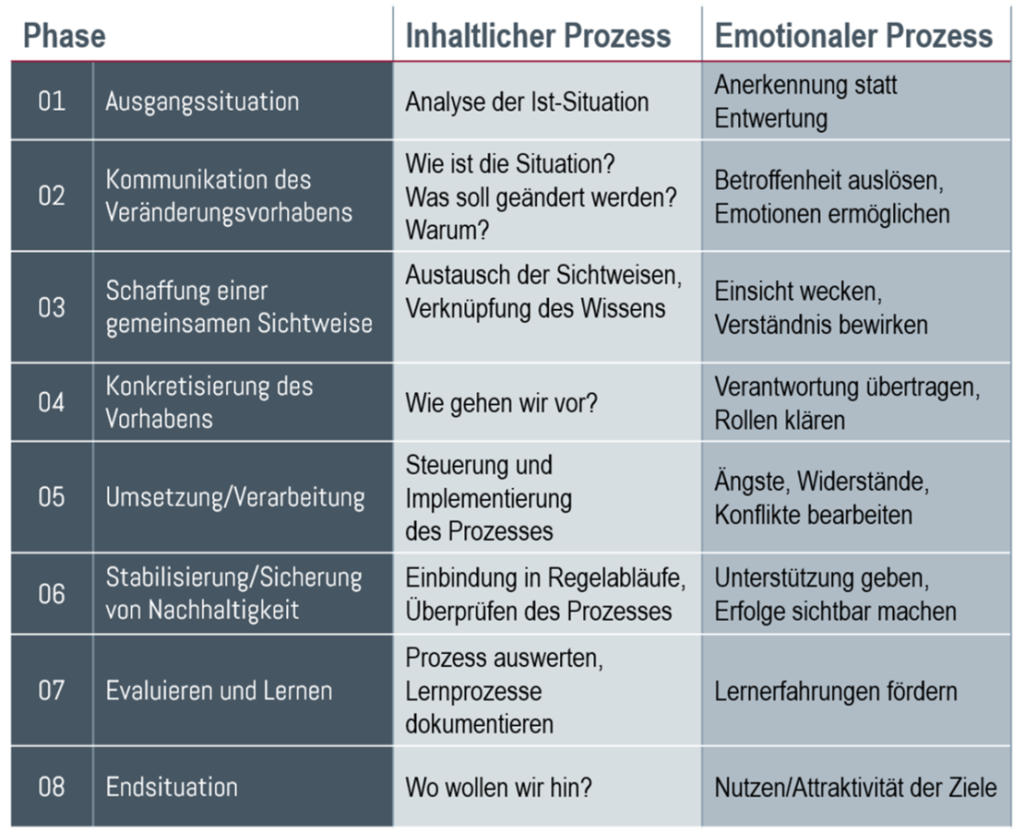
The employee magazine and the company intranet, for example, are important media for informing those affected. However, messages are much more effective if those affected hear them from people they trust - especially if they answer their questions in such a way that they appear authentic and therefore credible. Strategy implementation projects therefore need advocates at all levels, because only with their help can employees who were initially critical and distanced from the project be brought on board over time. There are various typical phases in every change project. It is not uncommon for a large proportion of employees to initially reject such a project when it is announced. Over time, they accept the planned change, first rationally and then emotionally, and become increasingly committed to achieving the desired goals. In the various phases of a change project, employees have different wishes, needs and expectations of their management. They should know their leader and respond to them.
The phases of a change project:
05 A qualification program that provides those affected with the necessary skills
When structures and processes as well as work content and relationships change in a company, this places new demands on employees. This means that they have to change their behavior and often their attitudes. Routines that they have developed over the years and that have given them security often become obsolete. Employees have to relearn or retrain. The company should support them with a training program and a coach or leader should help them develop new ways of thinking and behaving.
06 Simple tools and instruments for everyday work
In the so-called VUCA world, the framework conditions for economic activity in companies are changing ever faster. A central goal of almost all change projects has been for years: Employees should acquire the skills to independently recognize and solve problems and take advantage of opportunities for improvement. In order to show the desired initiative and responsibility, employees need easy-to-use tools. The company should provide them with these and train them in their use. We have developed a coaching tool specifically for coaching measures for our customers, which makes further training efficient and sustainable for employees and companies. TheCoachingPRO app offers comprehensive support for the coaching process through AI-supported coach search, budget and appointment overview, integrated online coaching, a logbook for target agreements, communication options with coaches via chat, feedback functions and access to coaches from 40 countries in 50 languages.
07 Rapidly demonstrable initial successes
"We want to become the most innovative company in our industry." "We want to become a global player." Achieving such goals usually takes years. During the course of the project, those involved often have the feeling that "nothing is moving", even if the company is on the right track. It is important to define milestones for the achievement of objectives - not only at company level, but also at divisional, team and employee level - so that the management can announce as often as possible: "We have achieved a partial objective." Otherwise the energy for change will flag.
08 Perseverance, tenacity and patience
Strategy implementation projects that are also aimed at cultural change require a great deal of perseverance and patience on the part of those responsible. Anchoring the desired new routines in the minds of employees and in the organization takes time. Under no circumstances should those responsible fall into an operational rush if the change is progressing too slowly, as the saying goes: "The grass doesn't grow faster if you pull on it." Instead, take steps in your private life, such as exercising or reflecting on what is happening with a coach, to ensure that you maintain your inner balance and continue to radiate the confidence needed to lead employees through change processes.
Article also published by HRweb - The fresh magazine for Human Resources
Author:
Hans-Peter Machwürth | Managing Director MTI
WE BRING YOUR STRATEGY TO LIFE
Strategy lives - through people and clear implementation. We support companies in making visions tangible and anchoring change sustainably in everyday life. Turning goals into concrete steps requires priorities, structures and communication that involves everyone involved. If you are considering how your change project can have an impact, please contact us - together we will develop approaches that successfully shape change.
You can find out what this can look like here: Case studies & experience reports